
Assessing Benin Republic's Counter-Terrorism Strategy
by

As armed activity continues to escalate across the Central Sahel, particularly in Mali, Niger, and Burkina Faso, the security crisis has increasingly spilled into the coastal states of West Africa. Countries once considered relatively insulated from the violence now face growing pressure from jihadist groups seeking to expand their operational reach. Among these states, Benin Republic has emerged as one of the countries most affected by the southward expansion of militant activity, particularly from Jama'at Nusrat al-Islam wal-Muslimin (JNIM).
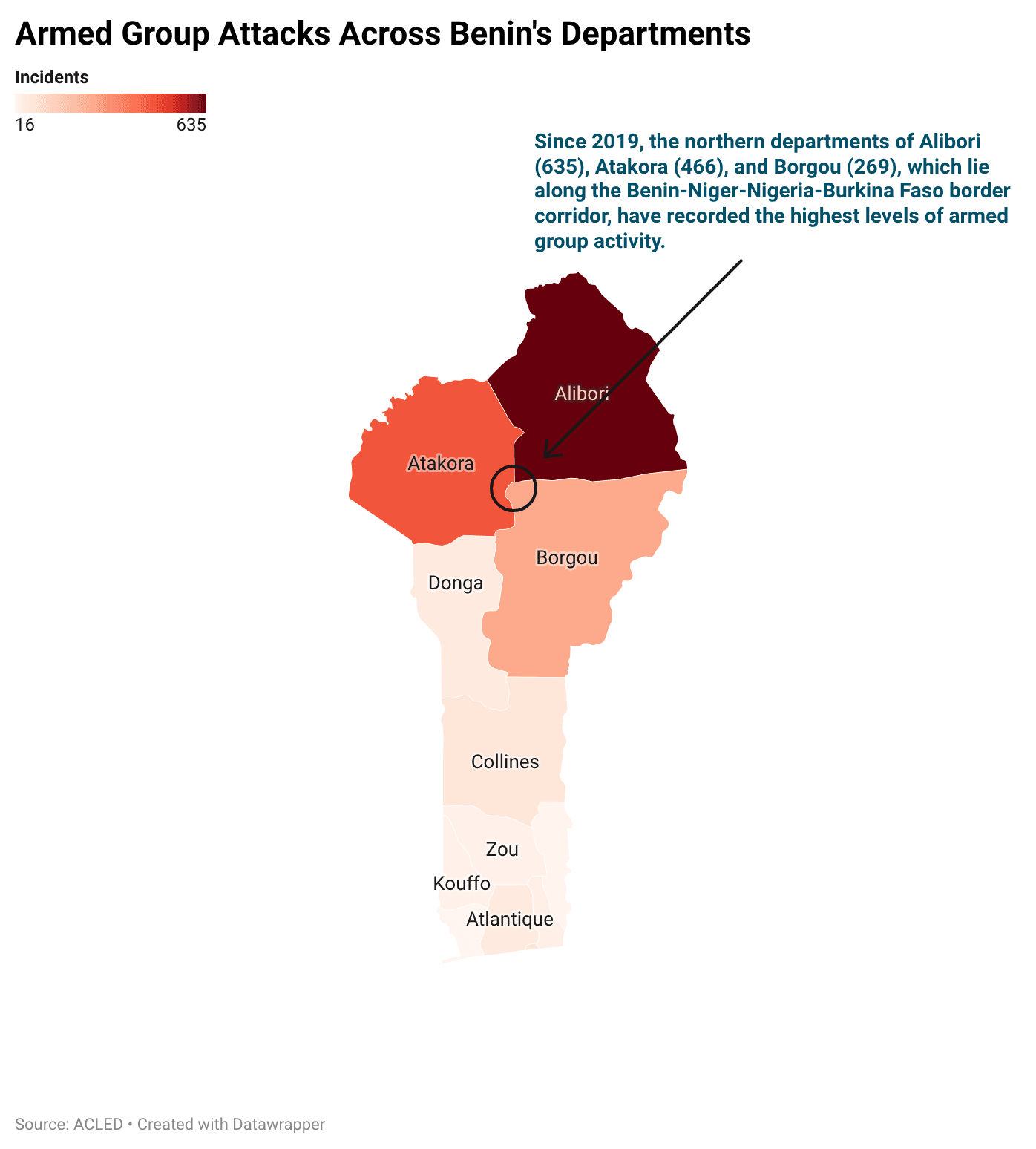
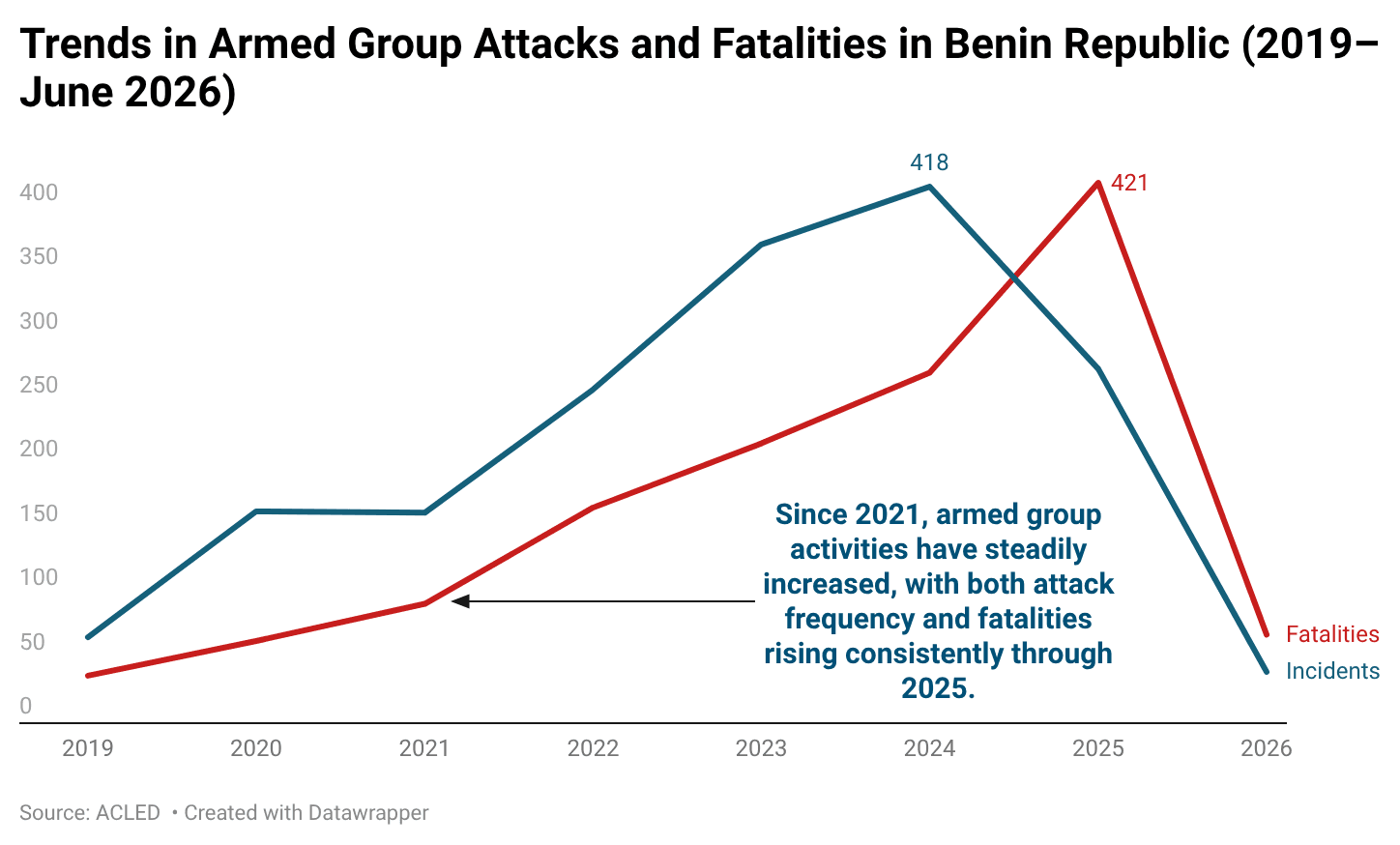
Since the first JNIM-linked incidents were recorded in 2021 in Benin's Pendjari National Park, violence has steadily intensified across the country's northern regions. Recent data from the Armed Conflict Location & Event Data Project (ACLED) attributed the worsening security situation in the Benin (Alibori, Atakora and Borgou departments), Niger (Dosso Region), and Nigeria (Sokoto, Kebbi, and Kwara states) border corridor to a sharp escalation in militant activity, with violence increasing by 86 percent and fatalities rising by 262 percent. These figures underscore the growing complexity and severity of the security environment across the tri-border region.
Furthermore, JNIM has strengthened its presence within the Pendjari Complex and parts of the Atacora Department along the border with Burkina Faso. The group's Katiba Hanifa faction has repeatedly launched incursions into Beninese territory, exploiting the porous border and difficult terrain. In one of the deadliest attacks recorded in recent years, militants killed 47 Beninese soldiers near the Burkina Faso border, highlighting both the operational capability of the group and the expanding geographical scope of the threat.
State Response to Armed Insurgence
In response, Beninese authorities have implemented a range of kinetic and non-kinetic measures aimed at containing the insurgency. On the military front, the government launched major security initiatives, including Operation Mirador and Operation Bouclier, while simultaneously strengthening intelligence, surveillance, and reconnaissance (ISR) capabilities. In parallel, the government has pursued several non-kinetic initiatives designed to strengthen community resilience, reduce local vulnerabilities, and limit opportunities for armed groups to establish influence within border communities.
Nevertheless, the persistence and increasing frequency of attacks suggest that significant gaps remain within both Benin's kinetic and non-kinetic response frameworks. Despite notable investments in security operations and community engagement, armed groups continue to demonstrate an ability to adapt, exploit local grievances, and sustain operational momentum across northern Benin. Consequently, a critical assessment of the country's current counter-terrorism strategy is necessary.
This piece examines the strengths and limitations of Benin's existing approach and identifies practical measures that could strengthen its response to the evolving threat, drawing on lessons and observable patterns from other countries confronting similar challenges across the region
Military Counter-Terrorism Strategy
The Beninese government has spent much of the past decade modernising, expanding, and restructuring its armed forces. The government has established several forward operating bases and military outposts along its borders in the northern region, recruited and deployed additional troops to frontline areas, acquired drones and armoured vehicles, and strengthened inter-agency security coordination. The Beninese Armed Forces have trained and deployed an estimated 8,200 personnel over the past eight years, while recruiting and training an additional 1,500 personnel in recent years.
Furthermore, the government launched several military operations to contain the expanding threat. Among the most prominent is Operation Mirador, which aims to strengthen security along Benin's northern frontier with Burkina Faso, Niger, and Nigeria, including the Park W complex. The operation deploys approximately 3,000 soldiers across eight forward operating bases and fortified positions throughout the region. Local security auxiliaries also support the operation through intelligence collection and community-based surveillance. In parallel, Benin has expanded its military arsenal through the acquisition of helicopters, drones, and armoured platforms. The government increased defence spending by approximately 60 percent between 2022 and 2024 and announced plans to recruit an additional 5,000 personnel to strengthen force capacity.
These investments have led to measurable tactical gains. During the final quarter of 2025 alone, security forces reportedly neutralised approximately 45 militants, arrested numerous suspects, and seized substantial quantities of weapons, ammunition, and logistical assets. Nevertheless, these battlefield successes have yet to translate into a sustained reduction in insecurity. Structural weaknesses within Benin's operational and strategic military architecture continue to limit the long-term effectiveness of these efforts.
Strategic Military Partnerships
Recognising that the escalating threat requires cooperation beyond its borders, Benin has pursued a series of strategic defence partnerships aimed at strengthening military capabilities, improving intelligence collection, and enhancing regional cross-border counter-terrorism coordination.
In early 2025, Benin signed a bilateral defence agreement with the United States. The partnership focuses on joint military exercises, troop training, operational support, and logistical assistance. Likewise, Benin has maintained close security ties with France, which continues to provide intelligence, surveillance, and reconnaissance (ISR) support to monitor militant movements. French forces have also collaborated closely with Beninese authorities on intelligence sharing and operational planning. Additionally, a small contingent of French special operations personnel remains engaged in training and advisory roles.
At the regional level, however, cooperation with neighbouring Burkina Faso and Niger has faced significant challenges despite the shared security threat. Following the military takeovers in both countries in 2022 and 2023, relations between the military-led governments and ECOWAS deteriorated sharply, undermining regional security coordination. Nevertheless, recent diplomatic engagement between President Romuald Wadagni and the governments in Niamey and Ouagadougou has created opportunities for rebuilding cross-border security cooperation.
Nigeria remains Benin's most significant regional security partner. Bilateral defence cooperation has expanded considerably in recent years, particularly following Nigeria's support during the attempted coup plot in Benin. Both countries have strengthened joint security initiatives, including Operation Atileyin Alaafia, which focuses on coordinated border patrols, intensive vehicle inspections, and intelligence sharing aimed at disrupting JNIM supply routes operating along the border corridor.
Recent operations under this framework reportedly contributed to the neutralisation of approximately 200 JNIM fighters operating along the Nigeria-Benin border areas, particularly around Kwara State. While these partnerships have strengthened military capabilities and improved operational coordination, the broader regional fragmentation witnessed over the past five years has created opportunities for militant groups to expand their presence across Benin and neighbouring states. Whether recent security gains can reverse this trend remains unclear.
Non-Kinetic Strategy
Alongside military operations and security partnerships, Benin has increasingly invested in non-kinetic approaches to address the underlying drivers of insecurity. Policymakers recognise that military force alone cannot resolve the structural conditions that enable violent extremism to flourish.
Given the socioeconomic vulnerabilities that characterise much of northern Benin, the government has prioritised initiatives designed to strengthen state presence, improve livelihoods, and reduce community susceptibility to militant influence. Before armed groups established a significant foothold in the country, the Beninese Agency for the Integrated Management of Border Areas (ABeGIEF) launched several development programmes aimed at reinforcing governance and promoting economic opportunities in remote border communities.
The government expanded these efforts in 2024 through the Resilience and Prevention Programme (PREP), which seeks to strengthen community resilience in fragile and conflict-affected areas. PREP combines investments in public services, social cohesion, food security, and livelihood support while also promoting land reforms intended to reduce resource-based tensions.
As insecurity intensified, authorities introduced additional measures, including income-generating projects, educational support programmes, and community peacebuilding initiatives across vulnerable communes and departments. These efforts also included the rehabilitation of public schools, expanded access to clean water, and the provision of veterinary services in remote pastoral communities. Despite these initiatives, implementation challenges have limited their overall impact. Consequently, many of the structural vulnerabilities that armed groups exploit continue to persist across affected regions.
Gaps and Recommendations
Although Benin's kinetic and non-kinetic strategies have delivered some positive outcomes, several critical gaps continue to undermine long-term effectiveness.
First, security forces must adapt more rapidly to the evolving threat environment. Armed groups operating across the Sahel increasingly employ drones, encrypted communications, sophisticated reconnaissance techniques, and coordinated assaults against military positions. Benin's forces must continue modernising their capabilities to keep pace with these developments.
Second, the current network of forward operating bases presents operational vulnerabilities. Many bases remain isolated, lightly fortified, and located far from the most active threat corridors. As a result, militants often retain freedom of movement between security positions, enabling them to conduct attacks against both military targets and civilian communities.
Third, military operations have not sufficiently targeted the economic enablers that sustain militant activity. Illicit economies within and around the Park W complex, including fuel smuggling, poaching, and cross-border trafficking networks, continue to generate revenue streams that support armed groups. Security operations should therefore place greater emphasis on disrupting these logistical and financial ecosystems.
Similarly, while Benin's non-kinetic programmes represent an important step forward, they do not adequately address several key drivers of instability. Policymakers should pay greater attention to farmer-herder tensions, competition over natural resources, governance deficits, and the marginalisation of Fulani communities, all of which feature prominently across conflict-affected areas in the Sahel.
Moving forward, Benin should align its security strategy with the evolving threat landscape. Authorities should expand the deployment of tactical drones to frontline units and forward operating bases for intelligence, surveillance, and reconnaissance missions. In selected cases, armed drone capabilities may also provide valuable force-multiplying effects. Additionally, the government should strengthen troop welfare and support systems to sustain morale among frontline personnel. While increased recruitment remains necessary, authorities must complement expansion efforts with improved welfare packages, equipment, and operational support.
Furthermore, security forces should intensify efforts against the logistical corridors and illicit economies that sustain militant operations. At the regional level, Benin should accelerate diplomatic engagement with Niger and Burkina Faso to restore cross-border security cooperation and facilitate joint operations against transnational armed groups. These measures remain critical if Benin hopes to keep pace with a rapidly evolving threat environment. As violent extremist groups continue to adapt their tactics across the Sahel and coastal West Africa, Benin's security strategy must evolve accordingly to prevent further deterioration of the security environment.
Afroangel Intel Admin
Afroangle Intel Admin
comments
No comments yet