
HOW BALOGUN MARKET WOMEN COMBINE MOTHERHOOD AND TRADE
by
Listen to this article
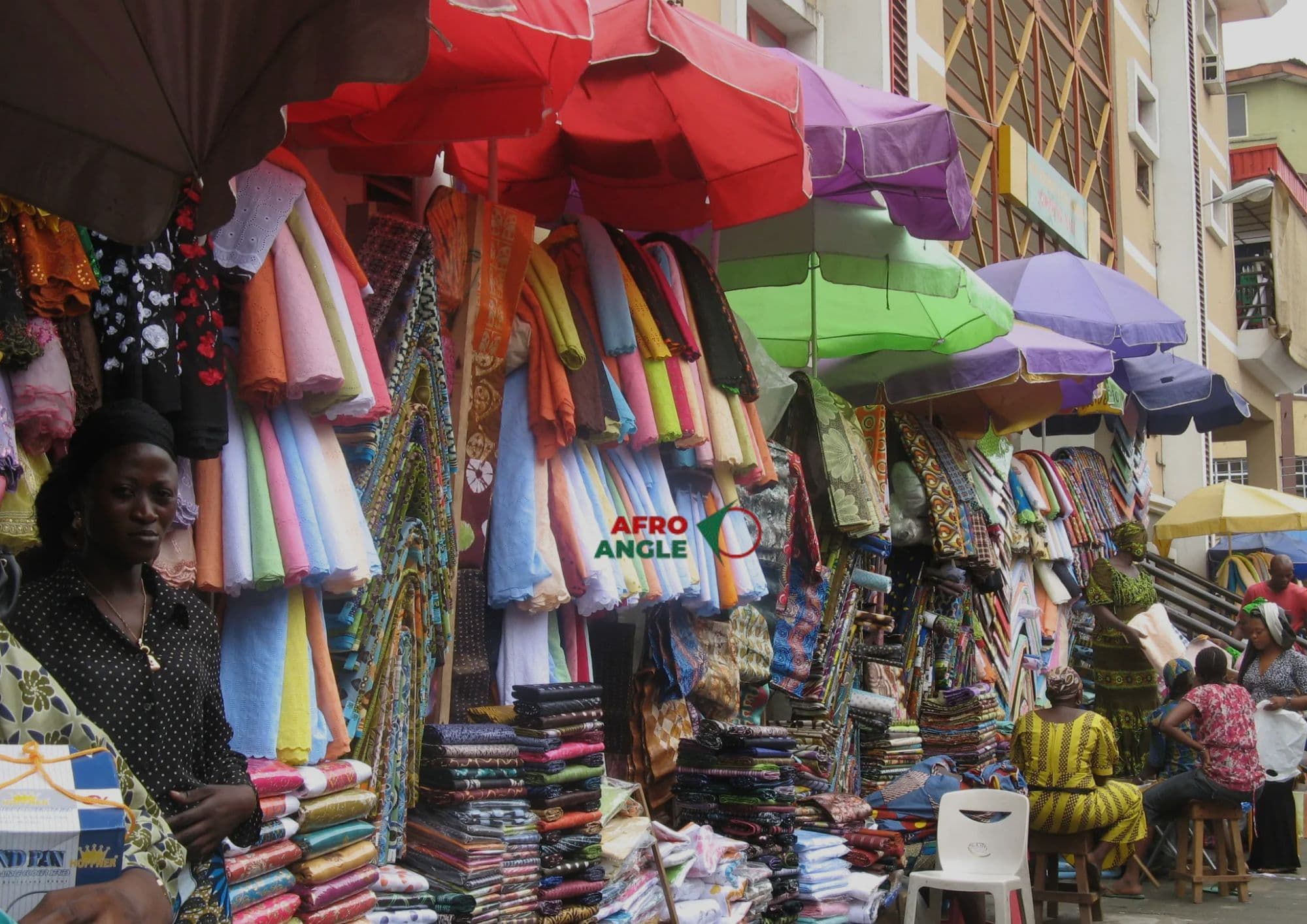
In Balogun Market, one of Lagos oldest and most vibrant trading hubs, Mrs. Adewale, known in her section as “Mama l’Aburo” for her decades of expertise in premium fabrics, mirrors the daily reality of countless market women who navigate the tension between earning a living and caregiving. “My children practically grew up on top of these lace bundles,” she says, recalling how her sons and daughters did homework amid stacks of Swiss lace and Austrian materials while she negotiated with customers.
Like Mrs. Adewale, thousands of women in Balogun Market, operate businesses that also sustain their households. But beyond trading, they carry a second, often unpaid, but dignifying, responsibility: managing family life alongside demanding market responsibility. Across Nigeria’s informal economy where women make up a large share of traders, this dual role is the norm, not the exception. With limited access to childcare, social protection, or flexible work structures, women in markets like Balogun are forced to simultaneously navigate income generation and caregiving, revealing how economic survival in urban Nigeria depends heavily on their unpaid labour.
Balogun Market’s history is as old as Lagos itself. The market sprawled across Lagos Island and is often considered one of West Africa’s largest open-air trading hubs, tracing its origin to the early 19th century. Over time, it pivoted from the slave economy into legitimate commerce in palm oil, textiles, accessories, household goods, after the British bombardment of Lagos in 1851. Through decades of economic shifts, currency changes, and government policies, these Balogun traders have turned commerce into an art and a survival skill, with women continuing to dominate its day-to-day operations across sectors.
The presence of these women reflects a broader structure of Nigeria’s informal economy. Despite its unstructured nature, it contributes massively to Lagos economy. More broadly, Nigeria’s informal economy is both vast and structurally central to the country’s overall economic activity and according to data from World Economics, the informal sector accounts for about 57.2% of Nigeria’s GDP, placing it among the largest shadow economies globally. This suggests that more than half of economic activity occurs outside formal taxation and regulatory systems, reflecting a system where livelihoods are sustained through small-scale, unregistered, and often survival-driven enterprises. This data also points to broader systemic issues, including weak governance structures and limited statistical reliability, which make it difficult to fully measure or regulate this sector.
The Moniepoint’s 2025 Informal Economy Report says Nigerian women in informal trade own just 35% of informal businesses in Nigeria, which is actually a slight decrease from 37% in the previous year. This gap is wider than the global average, where 55% of women participate in the informal economy compared to 60% of men. The report also highlights that women are slightly more likely than men to start family-run businesses, but overall, men still dominate ownership in this sector (65%). Most of these businesses are sole proprietorships, meaning the owner is responsible for every aspect of the business, but far from destabilizing families, these economic roles often enhance household responsibilities of these market women.
While the market has also modernized in scale and reach, these women traders continue to rely on inherited systems of resilience that require balancing economic activities with caregiving responsibilities, within a market that has long depended on their labour but rarely formalized their contributions.
Raising Children Between Stalls
For many of the women in Balogun Market, motherhood is inseparable from work, turning the market into both a place of business and a space where children are raised and socialized. Within this environment, values of resilience, discipline, and survival are passed down in real time. Mrs. Adewale says her success has been shaped by the constant improvisation of raising a family within the market. “You have to be a multitasker,” she says. “If you wait for a quiet time to be a mother, you will wait forever in Lagos.”
For Sister Ngozi, an electronics dealer, the balancing act is sustained not by time management alone but by networks of support. “It is a heavy load, I won’t lie,” she says, recalling days when she stays in the market until 9:00 p.m. supervising deliveries. Her solution is collective: a younger sister who handles school runs, and a husband who understands the demands of trade. “You cannot do this alone,” she says. “We are building a legacy for the children.”
Another trader, known as “Alhaja Gold,” balancing both worlds requires strict boundaries. “When I am in this shop, I am a lioness,” she says. “But when I get home, I drop that title at the door.” After navigating the pressures of selling high-value goods in a crowded market, she makes a deliberate effort to be present at home, sharing meals, listening, and reconnecting with her children despite exhaustion. “I don’t want to win in the market and lose in the home,” she says.
This reliance on informal support systems reflects broader patterns. With limited access to affordable childcare and social protection, many women traders construct their own safety nets: extended family members, older children, or paid domestic help when possible. Yet these systems are fragile, easily disrupted by illness, economic shocks, or rising living costs.
Studies on women in Nigeria’s informal sector note that many compress domestic tasks into pre-dawn hours and integrate children into the market space because affordable childcare is limited. Family and kinship networks often play a key role in how women enter and sustain trading, with many tracing their start to mothers or relatives, as seen in research on Yoruba textile traders in Balogun.
Inheriting More Than a Business
To understand Balogun Market, one must understand that children are not just dependents waiting at home, they are significant to these market women and overtime absorb the rhythms of trade almost by instinct. This intergenerational presence is central to the transfer of businesses from a mother to her children, for instance. For many of these market women, motherhood is not separate from work; it is embedded within it. The market is both a workplace and a site of socialization, where values of resilience, discipline, and survival are passed down in real time.
This system of women leadership, rooted in the Yoruba tradition, ensures orderliness amidst the market’s intense competitiveness. These women are not only building livelihoods; they are raising a generation that understands both the cost and value of work from an early age. Yet, over time, it has evolved into a form of inheritance. In this way, Balogun market sustains itself across generations, not only through commerce but through the continuity of care and labour.
With this arrangement, these women traders are raising a generation that understands both the cost and value of work from an early age. However, it is also a fragile legacy because it shows a system where economic survival depends on folding childhood into labour and motherhood into enterprise.
Abdulkabeer Tijani
Abdulkabeer Tijani is a Nigerian freelance journalist and visual storyteller with expertise on Nigeria’s media landscape. He has written for leading international media outlets including Al Jazeera, Minority Africa, International Journalists Network, The Continent, University World News and The Republic.
comments
No comments yet