
MEMORY AND MARGINALISED HISTORIES: BLACK SOLDIERS AND THE LIBERATION OF FRANCE IN TIERN MONENEMBO’S THE BLACK TERRORIST
by
Listen to this article
At the January 2026 meeting of world leaders hosted by the World Economic Forum (WEF) in Davos, Donald Trump affirmed before a stunned audience of European and North American leaders that the whole of Europe would have been speaking German, and a little Japanese had it not been for American strategic military intervention during the Second World War. In a single sentence, the statement evoked the horrors of a war that marked the twentieth century while reinscribing a familiar narrative of American exceptionalism. Trump’s speech intended to achieve two objectives: first, to remind the West of the United States’ invaluable contribution to the freedom, privileged global position, and peace it enjoys today when it could have been reduced to a feudal estate of Hitler’s Germany; and second, to mobilise this rhetoric as leverage in negotiations surrounding his expressed desire to acquire Greenland.
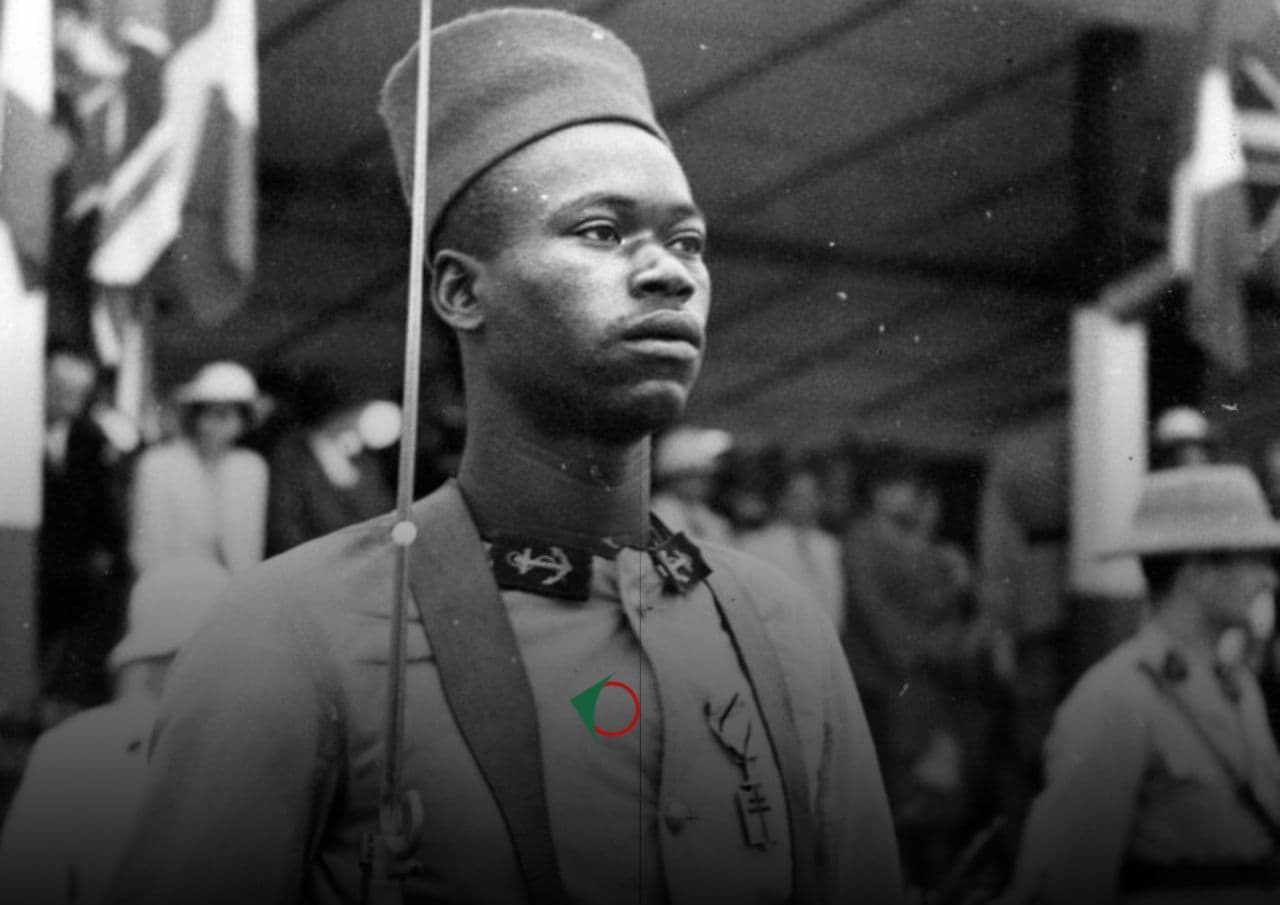
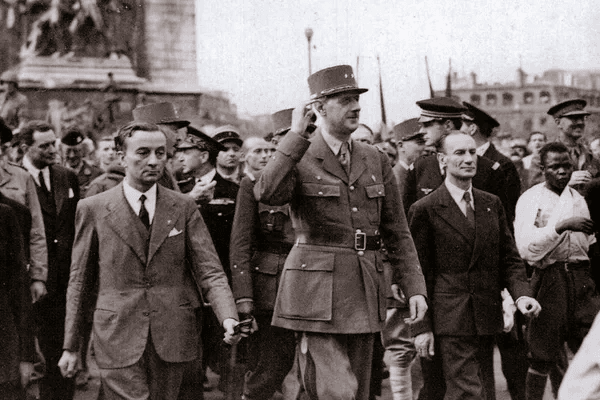
Yet embedded within this discourse, which continues to frame the United States as an indispensable Atlantic partner, is a strikingly expected absence of non-Western actors in this recollection of the gory past of Europe. In the characteristic manner in which accounts of Western historical narratives are shaped, the non-Western actors are eclipsed, and their contributions unacknowledged. The historical liberation of Paris in 1944, for example, witnessed the participation of black colonial soldiers who made up around two-thirds of the Free French Forces, according to a BBC Document Programme. Nonetheless, the French General Charles De Gaulle, who led these forces, intentionally removed the Black soldiers from the unit which led the Allied Forces’ advance into Paris to mark its liberation. This act remarkably displayed the intentionality of Western societies in erasing or under-representing the contribution of Black people to the making of what has become symbolic of their military glory.
Among the non-Western historical actors that deserve attention wherever and whenever the history of the World Wars Europe fought is being referenced are the Senegalese tirailleurs, a term with racial significance used by the French to categorise war recruits from French colonies in West and Central Africa. At the 80th commemoration ceremony of the massacre of a group of Senegalese tirailleurs by the French in the senegalese city of Thiaroye for demanding their unpaid wages after the Second World War ended, the President of the Republic of Senegal, Bassirou Diomaye Diakhar Faye described these historical actors as valorous men who “gave their youth, their blood, and their flesh for freedom and world peace.” His assertion was intended to recover their memory as brave men whose contributions to universal history deserve to be acknowledged. This address of 1 December 2024 is not the first to ever address the need to restore the memory of non-Western actors to the universal history of freedom from the claws of totalitarian Hitler’s Germany.
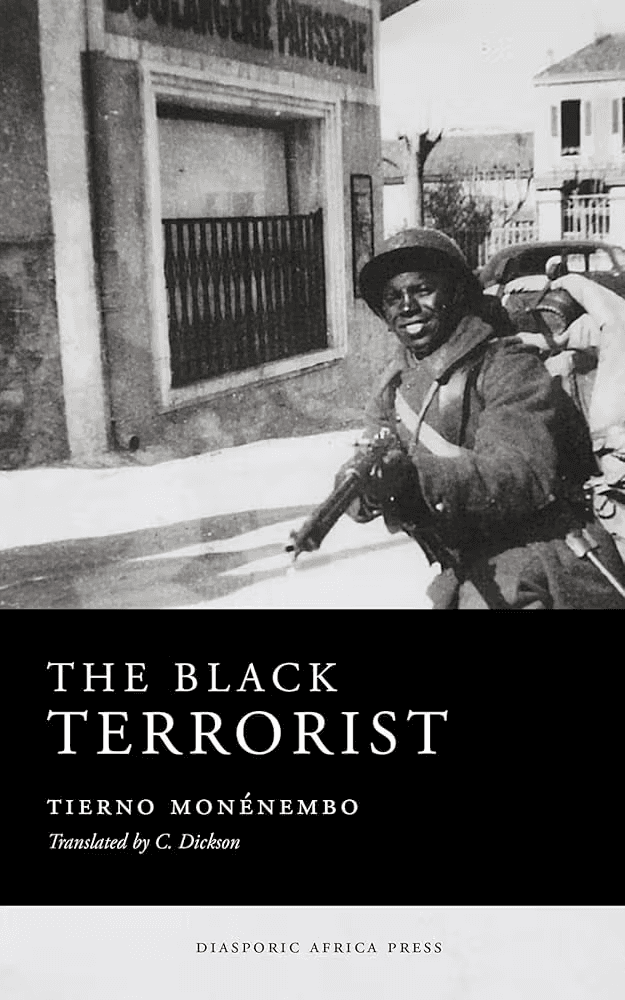
Before him, many African writers have–and are still committed to–made significant contributions through fiction and non-fictional oeuvres to this conversation. Primarily, colonial and postcolonial francophone writers such as Ferdinand Oyono, Camara Laye, Eza Boto, Massa Makan Diabaté, Tierno Monénembo, and Mbougar Sarr, among others, have broached, either passively or actively, the question of the two world wars that marked 20th-century history. Of interest for this discourse is Tierno Monénembo’s 2012 novel titled The Black terrorist (originally published as Le terroriste noir in French). In this historical fiction, Monénembo appropriates poetic liberty to reconstruct a lost time that can reposition Africa in 20th century world history. With the aesthetic choice of fabulation, a term coined by Saidiya Hartman, an American historian and literary scholar, to mean a practice that facilitates the combination of archival resources with speculative narrative to fill in the gaps in history with the objective of challenging hegemonic colonial narratives, Monénembo not only reconstructs the history of the Second World War. He took a further step to reclaim the humanity of nameless soldiers by unveiling their personal stories, passions, sentiments, fears, and agency, articulating what remains silenced by the archival gap. But what does he do with the fragmented memory of Black soldiers embedded in archival institutions? How do these fragments enrich his project of memorial reconstruction and present to his readers the Black condition across two different eras–colonial and postcolonial? To answer this question, I will begin with a summary of the Black terrorist.
SUMMARY OF THE BLACK TERRORIST
The novel tells the story of a young Senegalese-Guinean soldier during the Second World War. Born in Guinea under French colonisation, the protagonist named Addi Bâ arrived in France at the age of 13 with a French family. The novel presents his adoption by the Frenchman as a hand of fate. His biological father had consulted a Bambara diviner who told him to offer his son to the first white man he would meet, as fate demanded that the son leave his father to avoid a curse. Thus, Addi Bâ became the adopted child of a Frenchman. During the Second World War, he was called up for military service. In the heat of the war, he was captured by the Germans and escaped captivity with other Senegalese tirailleurs. It was in a village in the Vosges, in the eastern part of France, that he was found injured in the bush and rescued by the inhabitants, who were seeing a black person for the first time. His story of glory began in this village, where he created the first resistance group against the German Occupation in France. Denounced by an unknown person, the group was hunted down, and Addi Bâ was arrested and sentenced to death. Sixty years later, Germaine Tergoresse, one of the girls from the village in the Vosges mountains with whom the soldier lived, tells her own side of the story and that of the Vosges to Addi Bâ, the nephew and namesake of the hero, who came from Guinea to receive the medal of recognition for his uncle's contribution to the French Resistance.
REALITY AND FICTION IN MONÉNEMBO’S WORK
A relevant question when addressing the relationship between reality and fiction in a literary work concerns the role that what is “real” plays in creating fiction. The real often functions as the source of a literary work, providing fiction with its creative and historical context. In The Black terrorist, the archival material documenting fragments of Mamadou Hady Bah’s life and his participation in a resistance group constitutes the foundational context upon which Tierno Monénembo constructs his narrative. The novel’s protagonist, Addi Bâ, represents the historical figure Mamadou Hady Bah, born in Guinea in 1916. Bah arrived in France around 1937 with the family of a retired French tax collector who had served in Guinea. He later fought for France alongside other Senegalese tirailleurs in the 12th Regiment and was executed in 1943. Monénembo states that he sought “to recreate Hady Bah’s personality as much as possible, both physically and psychologically.” This statement underscores the extent to which the fictional character cannot be dissociated from the historical figure, revealing how the real and the imagined merge to produce Monénembo’s historical hero.
The recovery of memory is further integrated into the plot through the creation of fictional characters within a village setting who actively seek recognition for the forgotten hero of the Vosges. The heroes of the Vosges, thus, become a group of cosmopolitan interracial resistant fighters setting up an underground defence system to challenge the occupation of France by the Germans. Since these heroes' memories remained buried in archival records and erased from popular historical narratives, Monénembo’s choice of secondary characters, such as Pinéguette, centralises the collective efforts of everyday people in challenging official narratives. For instance, Pinéguette acted as the push Colonel Melun needed to realise the importance of resurrecting these buried memories by spotlighting an African who became the face of the French resistance in the Vosges and got labelled as the Black terrorist by the Germans. Through this characterisation, Monénembo exercises the freedom to fictionalise his narrative while drawing on historical referents.
Colonel Melun, for instance, evokes the historical figure Maurice Rives, though his name is fictionalised. Similarly, the narrative's spatial setting is modified to emphasise the novel’s fictional dimension. Rather than retaining Tollincourt, the real village where Hady Bah lived, Monénembo introduces Romaincourt as its fictional counterpart. This alteration allows the author greater narrative freedom to construct a space that transcends rigid continental and cultural boundaries. One may wonder if the fictionalisation of events and the distortion in the orthography of names cast doubt on the veracity of the narrative Monénembo presents in this novel. This would matter only to whoever reads fiction as the opposite of truth. Chinua Achebe captures the description of fiction in an interview he granted in 2008 on the occasion of the 50th anniversary of the publication of his Things Fall Apart. Achebe explained the choice of his novel's time setting and why he painted the end of an era and the beginning of another. According to his assertion, he wanted to tell a story that invoked something real about a particular period. In other words, he emphasised that fiction can be true; it is not necessarily the opposite of truth. Monénembo’s aesthetic choice follows this same logic by making Romaincourt a figuration infused with elements of Addy Bâ’s African origin. Hence, we see a communal setting with cockcrows announcing the new day and communal life shaping social relations. Through this hybridised setting, Monénembo destabilises the presumed opposition between Europe and Africa, suggesting instead a shared human and cultural sensibilities.
Temporality also plays a crucial role in the narrative structure. The novel unfolds sixty years after the execution of the protagonist, corresponding historically to 13 July 2003. This temporal distance enables the arrival of Addi Bâ’s nephew and namesake in France to represent him during commemorative efforts that required a posthumous national award to the hero. While there, his nephew and namesake encounters Germaine Tergoresse, who embodies the living memory of his uncle’s existence. Tergoresse then functions as a key instrument in Monénembo’s subversive narrative strategy: through her, French society reflects an African value system centred on memory transmission. By transforming Tergoresse into the living archive of Addi Bâ’s life, Monénembo amplifies the status of orality as the vehicle of transmission of the history of the everyday people, a space that is not mediated by the political objective of the power structure that seeks to dominate and violate for self-gains. Through this elevation of human imagination and orality as a form of transmission to the rank of archival documentation and textual rendering of historical accounts, the author characterises Germaine Tergoresse as a figure analogous to the griot, entrusted with preserving and transmitting history across generations. This fictional configuration reinforces the novel’s central objective: to revive the memory of the forgotten and ensure its survival beyond the silences of official history.
NAMING AS AN ACT OF MEMORY RECOVERY
In his tribute to the Senegalese tirailleurs who died for France, Senghor writes, ‘We lay flowers on the graves, we warm the Unknown Soldier. But you, my forgotten brothers, no one names you.’ This expression demonstrates the status of the Senegalese soldier engaged in the defence of France during the Second World War. His portrait is reduced to that of the unknown, and as an unknown, he is relegated to the obscure part of human history. In the Black terrorist, we see a reaction to this condemnation to the obscurity of unnamed and unknown tirailleurs. To know someone, you must first know their name. Although physical traits and cultural affiliation are important for identification, the marker of individuality is first and foremost emphasised by a person’s name. Thus, by giving names to the tirailleurs in this work, their individuality is amplified above the collective tag that anonymised their respective identities and reduced them to statistics and an Othered entity, since tirailleurs echoes a racialised French Army where the non-White are othered as tirailleurs. Saying “tirailleurs” is a grouping of different personal identities, whereas mentioning Fodé Soumah, a tirailleur in Monénembo’s work, refers to a definite entity, with familiar ties and complete identity. Germaine, being the living archive, becomes the voice of remembrance. She met and knew Addi Bâ. It is through the recounting of her conversation with him that we then witness the recovery of the individuality of those who had hitherto remained unnamed in History. She says:
All the men who were hunted down, who were hung, executed, banished—all of them, I say—haunted him while he was delirious with fever. It was at least a week before he regained consciousness and was able to sit up on the edge of the bed by himself and eat the bowl of soup Mama held out to him. And the names he mumbled as he lay near death still remain in my mind as if they’d just been etched there. Farara Dantillah, Boubacar Diallo, Moriba Doumbouya, Moussa Kondé, Fodé Soumah, Zana, Adama Diougal, Nouffé Koumbou. And especially, the most resonant, most moving, most unforgettable name of all because it was the one he raved about most often: Va Messié, Va Messié, Va Messié! (p. 24)
She begins by describing these riflemen in general terms. They are the hunted, the hanged, the shot, and the exiled. This general description obscures their individual identities. It must also be recognised that these labels contribute to erasing their cultural origins, which could lie in Guinea, Sudan, Côte d’Ivoire, or Senegal. The mention of these names is an attempt to frame them in the collective memory as individuals belonging to different societies under French colonial rule. The ‘forgotten’ had a cultural identity. They had their own names. Consequently, giving them names immortalises their memory and references their cultural belongings.
However, there is a pluralised identity of Addi Bâ. First, he is this Senegalese-Guinean soldier who is represented in his entirety, including his origins, his journey, and his social and military connections. In the Vosges, he becomes the Foreigner, an integrated Other who becomes part of everyday life in the village, even going so far as to form a resistance group to defend its territorial integrity against the German Occupation. At the warfront and among his fellow soldiers, he was first a tirailleur, then became the leader of a fighting bloc. To the Boches, who are the German invaders, he is the black terrorist. However, in everyday life in the Vosges, he maintains his status as the charming man who attracts the women of the village, and the man who becomes the adopted father of Pinéguette, a bastard daughter who will grow up to claim recognition of his paternity and also fight for recognition of his heroic exploits for the French Republic. Thus, he undergoes an identity shift, first from an African from Africa to an African residing in France; then he becomes a tirailleur before ending up as a French resistance fighter and a terrorist to the Boches.
The choice of a real person's name for the main character in this novel underscores the presence of a Black man in the Vosges during the Second World War and equally establishes his contribution to the French resistance. By situating Addi Bâ’s life in the Vosges, the fictional historical narrative challenges the claims that diminish or contest the contribution of Black soldiers to the French liberation efforts. It is a way of affirming that the freedom from the Germans, which also marked the victory of the Allied Forces against Hitler, required also the blood sacrifice of the colonised. Forgetting or diminishing this contribution, thus, constitutes a violence against the memory of soldiers like Addi Bâ, who still require advocacy to be remembered. This is what makes the diverse portraits of Addi Bâ in the novel important. Germaine’s subjectivity and her portrayal of the hero humanise him. She tells his nephew that:
I just want you to know one thing, Mister, your uncle is not a hero—he’s much more than that. Heroes can be found in granite and bronze. Let them cut their ribbons and bring on their fanfares! To me, he is first and foremost the friend or the father almost everyone would have liked to have . (p. 12)
CONCLUSION
The Black terrorist is a historically inspired novel that reconfigures the image of Senegalese riflemen through the portrayal of the character Adi Bâ, as narrated by Germaine Tergoresse. In a world that amplifies Western exceptionalism to the detriment of erasing contributions of fighters from other parts of the world in liberating Europe from the claws of the NAZI, Monénembo draws on the richness found in history as a discipline concerned with certainty while deploying literary narrative techniques to construct a more complete story that embodies the experience of African Resistance Fighters during the Second World War. He turns Germaine Tergoresse into a griot, a lieu de mémoire, an embodied site where memory crystallises and historical continuity resists oblivion. He also names the tirailleurs and uses a first-person singular narrative perspective to demonstrate the humanity of these forgotten figures of history and their contribution to their host nation during the war, particularly Adi Bâ's role in Vosges society. So when we hear from high places how the liberation of Paris, and France in particular, was an exclusive demonstration of Western heroism, we must always remember the unnamed African soldiers from the colonies who fought, died, and resisted Hitler’s soldiers to make France the bastion of freedom it claims to be today.
Isreal Winlade
Isreal Winlade is a writer with interest in literary criticism and history.
comments
Michel deTena
31w
An excellent piece! I need to read the novel myself because this account seems really intriguing. While I was having a discussion with a friend from Haiti recently, he told me the same thing about Haitians who fought in the war for the independence of the United States.