
Nigerian Police Assume Greater Combat Role Amid Escalating Violence Across Northern Nigeria
by
Security Situation Report (June 14 – June 20, 2026)
Introduction
The security landscape across Northern Nigeria remains highly volatile as insurgent and bandit groups continue to intensify attacks against civilians and security personnel. Although Nigerian security forces have sustained counterterrorism and counter-banditry operations across multiple theatres, the persistence and adaptability of armed groups continue to challenge security responses.
The North-West recorded a significant escalation in violent activity during the reporting period, with attacks targeting both civilian communities and security forces. A notable development was the increasing use of improvised explosive devices (IEDs) by armed groups. The onset of the rainy season and the region's difficult terrain have created conditions that allow militants to emplace explosive devices with reduced risk of detection.
Two major IED incidents occurred during the reporting period. In Dan Musa Local Government Area of Katsina State, an explosion killed three civilians. In a separate incident along the Bagega-Anka corridor in Anka Local Government Area of Zamfara State, an IED strike targeted an escort convoy, killing three police officers and six civilians. These attacks highlight the growing sophistication of armed groups and their increasing reliance on asymmetric tactics to inflict casualties and disrupt security operations.
Meanwhile, insurgent groups operating across the North-West continue to expand, consolidate, and deepen their presence in strategic locations. According to open-source reporting, fighters linked to Jama'at Nusrat al-Islam wal-Muslimin (JNIM) reportedly arrived in Gyalange village in Gummi Local Government Area of Zamfara State more than two weeks ago and have since maintained a presence in the area while engaging with local communities.
Similarly, the Islamic State Sahel Province (ISSP) appears to be strengthening its footprint in the region. Reports indicate that suspected ISSP fighters attacked and burned a Nigeria Security and Civil Defence Corps (NSCDC) office in Tsamiya village, Bagudo Local Government Area of Kebbi State. Furthermore, Lakurawa elements continue to operate across parts of the region. However, Nigerian security forces recently ambushed a group of Lakurawa fighters en route to Gwalli in Zamfara State, killing six fighters and injuring several others.
In parallel, the Federal Government has intensified its broader counterterrorism efforts nationwide. Authorities recently commenced the trial of more than 500 terrorism suspects as part of efforts to accelerate the prosecution of terrorism-related offences and strengthen judicial accountability.
On the military front, security forces have expanded offensive operations in the North-East, intensifying pressure on Boko Haram strongholds in the Sambisa Forest and surrounding areas of Gwoza Local Government Area. Likewise, the military has sustained precision air operations in the North-West, including recent strikes targeting armed groups in Giwa Local Government Area of Kaduna State.
Furthermore, Nigeria's security architecture is undergoing a notable operational shift. In recent weeks, the Nigeria Police Force has assumed a more active combat role in counterterrorism and counter-banditry operations across the country. The police have increased frontline deployments, expanded escort operations along vulnerable transportation corridors, and launched nationwide operations aimed at intercepting fleeing bandits, terrorists, and criminal networks. A move that will potentially reshape the operational landscape in the fight against armed groups.
Weekly Review
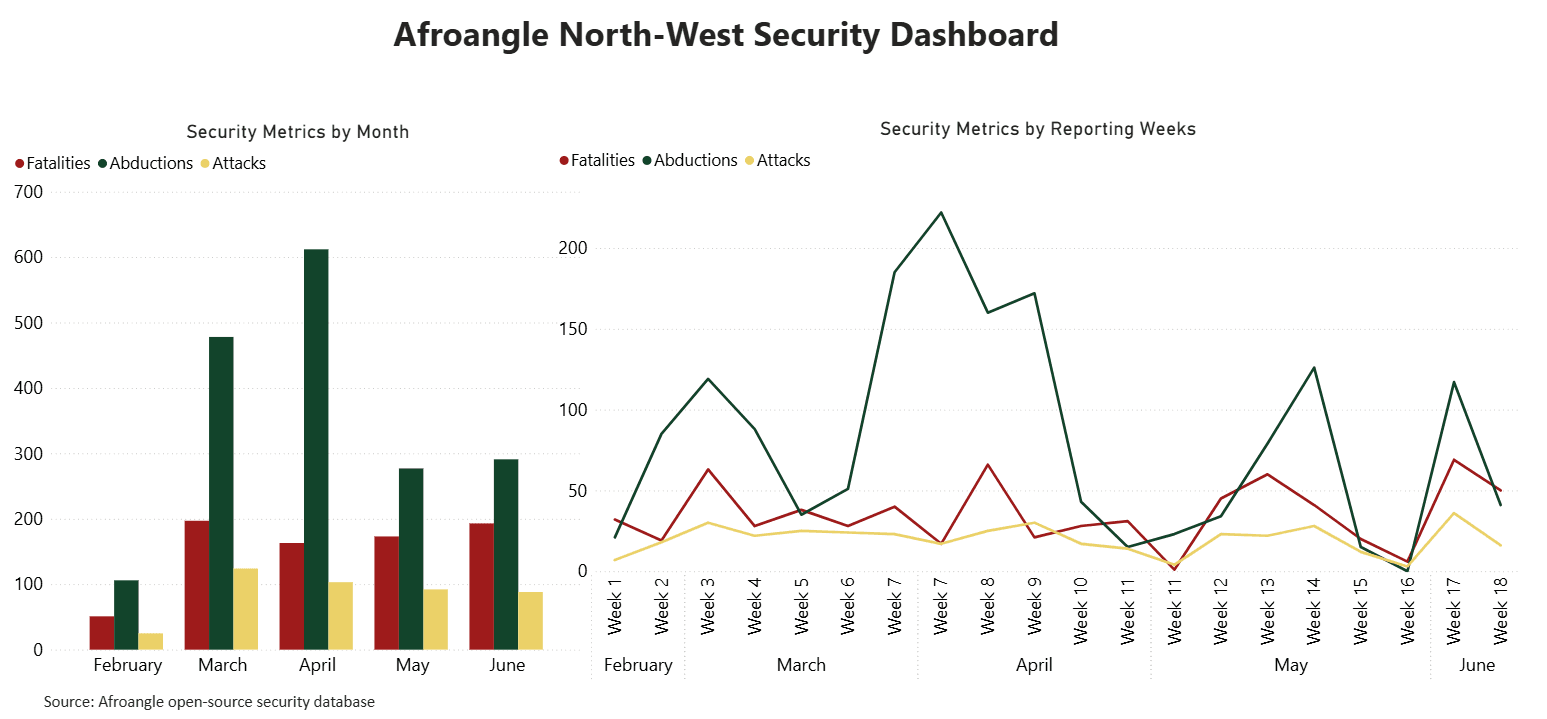
Security data from the North-West indicate that violence remains persistent despite a notable decline in several key indicators during the reporting period. Recorded incidents fell to 16, representing a 63% decrease from the previous week. However, the reduction in incident volume did not translate into lower lethality. Fatalities rose to 50, marking a 16% increase and underscoring the continued severity of attacks across the region. In contrast, abductions declined significantly, with 41 victims kidnapped compared to the previous reporting period, representing a 72% decrease. Nevertheless, the decline in incidents and kidnappings should not obscure the broader security reality.
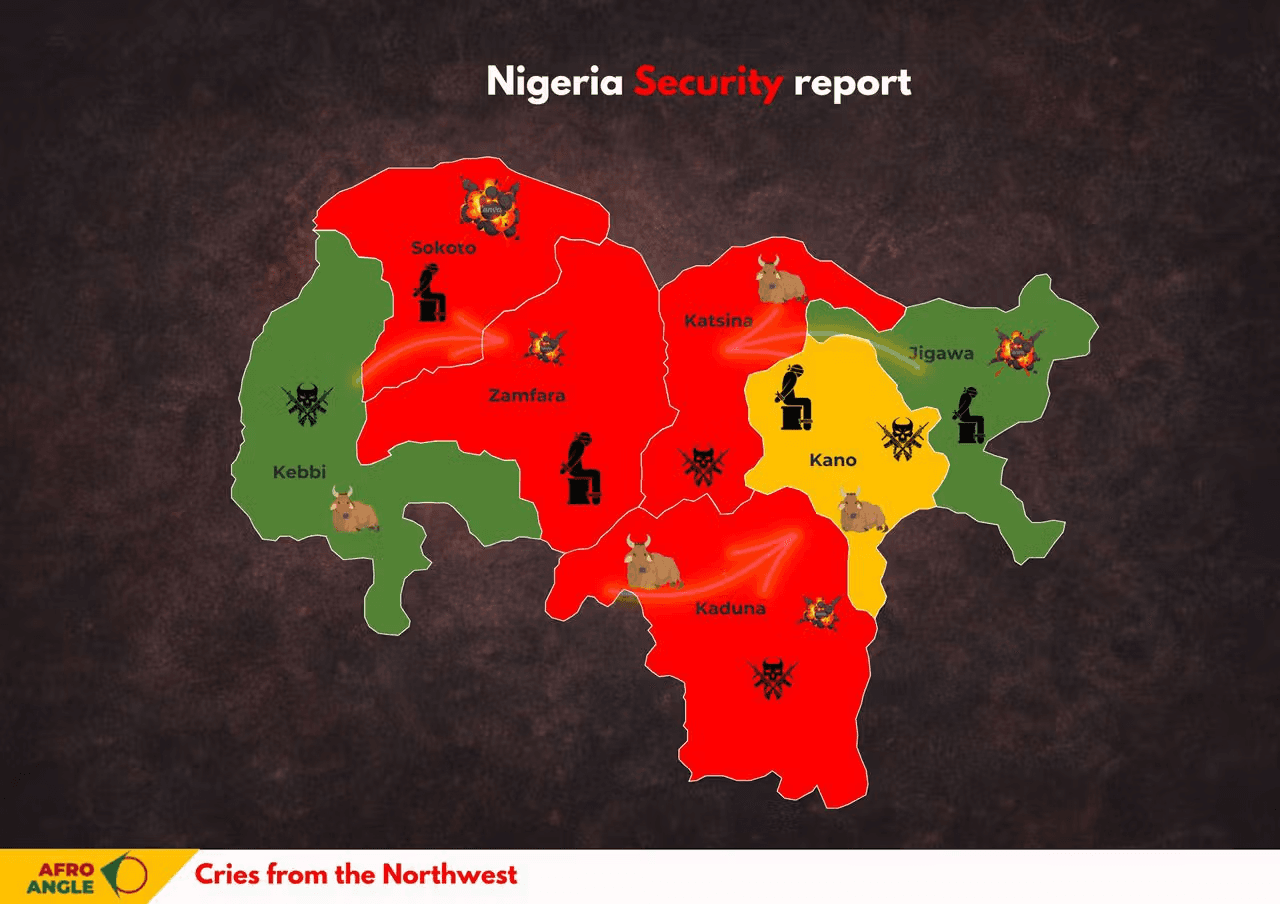
At the state level, Kaduna, Katsina, Sokoto, and Zamfara each recorded four security incidents, reflecting the broad geographic spread of violence across the North-West. However, the distribution of fatalities reveals a more concentrated pattern. Katsina State accounted for 33 deaths, making it the most lethal theatre during the reporting period, while Zamfara recorded 11 fatalities. In terms of abductions, Sokoto recorded the highest number with 26 victims, followed by Kaduna with 15. This distribution highlights the increasingly dispersed nature of insecurity across the region. While incident frequency has declined, armed groups continue to retain the operational capability to conduct high-impact attacks across multiple states.
Nigerian Police Assume a Frontline Role in Counter-Terrorism Operations
Nigeria has grappled with complex security challenges for more than two decades. Across the country, armed groups continue to escalate attacks, transforming large parts of the country, particularly rural communities, into active conflict zones. Amid these multidimensional security threats, the military has remained the principal institution responsible for counter-terrorism and counter-banditry operations.
Consequently, debates have intensified over the military's extensive involvement in internal security operations, with many observers arguing that such deployments divert attention from its core mandate of defending Nigeria's territorial integrity and sovereignty against external threats. Over the course of these prolonged campaigns, the military has maintained an extensive nationwide presence, resulting in operational overstretch and increased pressure on personnel and resources. This burden has partly stemmed from the limited capacity, funding constraints, and manpower shortages within the Nigeria Police Force.
However, recent developments suggest that the police are gradually reclaiming their constitutional responsibility as the primary internal security institution. While the police have consistently contributed to counter-terrorism and law enforcement efforts, recent operations demonstrate a more visible and proactive frontline role in addressing security threats across the country.
Several incidents illustrate this evolving operational posture. In the Federal Capital Territory, police units conducted clearance operations against armed groups operating from forested areas that had served as sanctuaries for criminal elements. These operations led to the destruction of hideouts and the neutralisation of several suspects. In Zamfara State, the Nigeria Police Force provided armed escort services along the high-risk Anka–Bagega corridor to protect civilian commuters. The force launched counter-IED operations to detect and neutralise explosive threats along high-risk routes, a responsibility traditionally associated with military units.
Similarly, widely circulated footage on social media showed police personnel deployed to abandoned communities in Owa-Onire, Ifelodun Local Government Area of Kwara State, where they established a security presence to deter armed groups and reassure residents. Furthermore, one of the most notable recent operations involved the elimination of the notorious bandit commander Kachalla Ibrahim Battijo in Kogi State. The operation involved the Nigeria Police Force, the Nigerian Army, and the Office of the National Security Adviser, with police aviation assets providing aerial surveillance and operational support to ground forces.
These developments indicate a significant institutional shift within the Nigeria Police Force. Increased police participation in frontline security operations could enhance overall operational effectiveness by strengthening interagency coordination and reducing the burden on military formations. Furthermore, a more active police role could improve stabilisation efforts in conflict-affected areas. While military forces conduct offensive operations to clear armed groups from contested territories, police units can maintain a sustained security presence, consolidate gains, and prevent the re-establishment of insurgent or criminal networks.
Moreover, this evolving role could improve public perceptions of the police. For years, public confidence in the force has suffered due to concerns over corruption, inadequate capacity, and limited effectiveness in addressing security threats. Greater operational visibility and successful security interventions could strengthen the institution's credibility and reinforce public trust.
Nevertheless, the sustainability of this emerging posture will depend on the force's ability to address longstanding structural challenges. The police must invest in specialised training, strengthen rapid-response capabilities, procure modern equipment, improve personnel welfare, and enhance operational mobility. Equally important, the institution must tackle systemic issues such as corruption, bribery, and accountability deficits to ensure long-term effectiveness and public confidence.
Overall, this development represents an important evolution in Nigeria's security architecture. If sustained, it could strengthen operational effectiveness through enhanced interagency cooperation, improved force distribution, and a more balanced security framework for combating terrorism, banditry, and organised violence.
Outlook
In the coming weeks, northern Nigeria will likely continue to experience sustained violence alongside intensified counter-terrorism operations. In the North-East, the military will maintain offensive operations against Boko Haram and ISWAP strongholds in the Sambisa Forest, supported by continued air operations and intelligence-driven targeting.
Meanwhile, the North-West may witness increasing competition among armed actors, particularly as JNIM, ISSP, Lakurawa, and local bandit factions seek to expand their influence, control territory, and secure critical supply corridors. This evolving militant ecosystem raises the possibility of both cooperation and confrontation among these groups as they compete for resources and operational space.
Furthermore, armed groups will likely continue to deploy improvised explosive devices to disrupt security operations, restrict civilian movement, and inflict casualties on both security personnel and local populations. The rainy season and deteriorating road conditions provide ideal conditions for concealing explosive devices and complicating detection efforts.
Finally, security agencies should prioritise civilian protection in high-risk communities. Attacks against vulnerable populations, farming settlements, and remote rural communities will likely persist in the short term, particularly as armed groups exploit seasonal mobility challenges facing government forces. Strengthening rapid-response mechanisms, intelligence collection, and community-based early-warning networks will remain essential to mitigating these threats.
Afroangel Intel Admin
Afroangle Intel Admin
comments
No comments yet