
Nigeria’s Forest Security Gaps Likely Opened Path to Growing Insecurity
by

Nigeria's forests are falling, and the men sent to save them are dying in the dark.
The Ogbomoso school abduction occurred on the morning of 15 May 2026, when armed men stormed the compound. One teacher was shot dead at the entrance. A second teacher, along with 39 students and 6 other school staff, was seized and dragged across the back fence into the dense forest fringe that separates Ogbomoso from the Oyo-Osun reserve corridor. By the time security forces arrived, the compound was empty of everything except shell casings and overturned chairs.
The attack shocked a nation that thought it understood where the violence lived. Bandits, the loosely organised armed groups that have terrorised the Northwest for a decade, were a northern problem. They belonged to Zamfara's red laterite hills, to Kaduna's Birnin Gwari axis, and to the vast ungoverned stretches of Kebbi and Katsina. They did not, the prevailing assumption went, belong in Oyo State, in a town that sits barely 130 kilometres north of Ibadan, in the country's commercial heartland.
To understand how armed men reached a secondary school in Oyo State, you must trace a line south from the Niger River. It begins in the sprawling reserves of northwestern Nigeria, Zamfara, Katsina, and Kaduna, where bandit groups have operated since at least 2011, initially as cattle rustlers and later as kidnappers commanding multimillion-naira ransoms. Over the following decade, they grew in organisation, firepower, and geographic ambition.
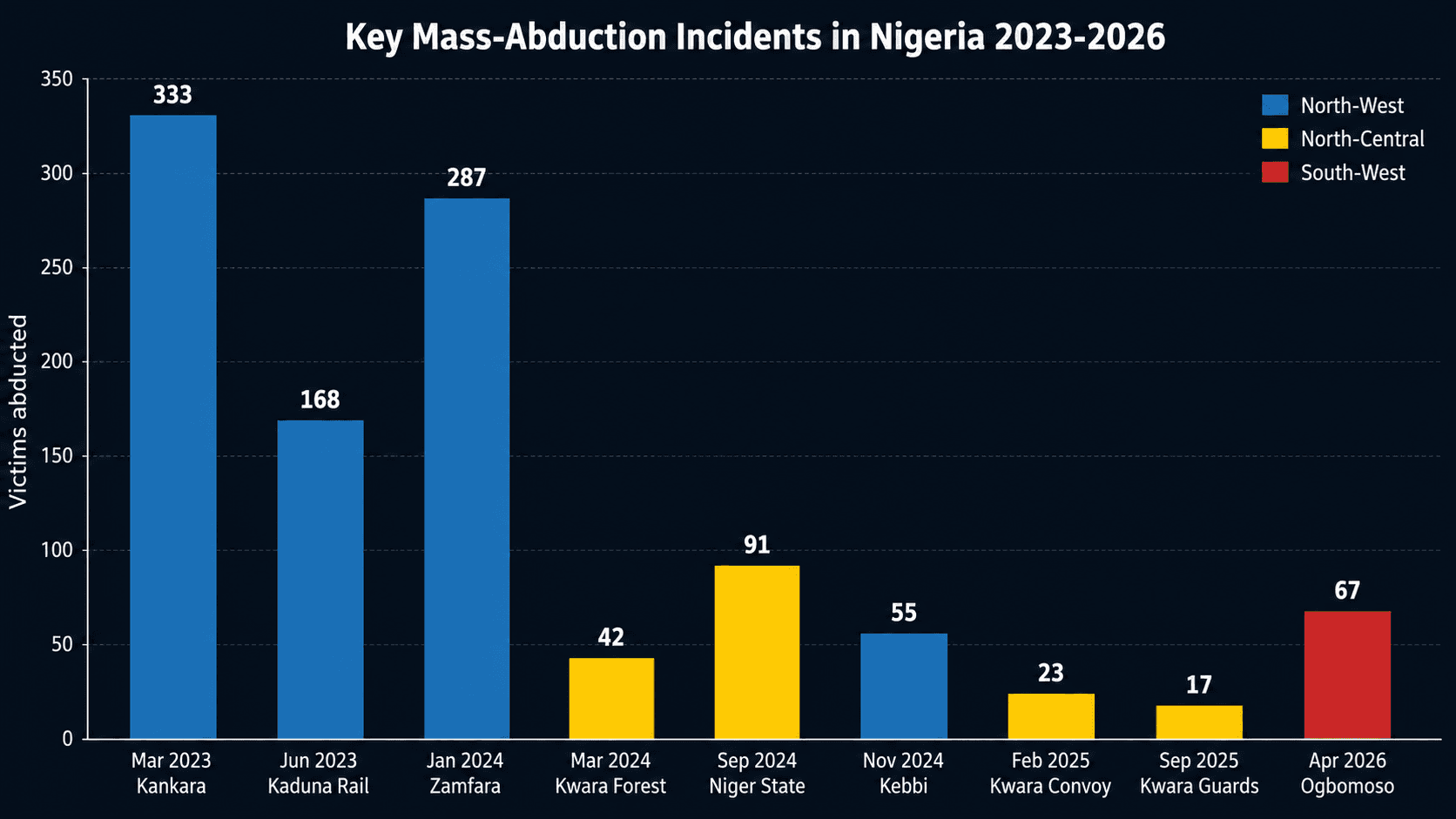
Fig. 1
The critical turn came as pressure mounted in the northwest. Sustained military operations, community vigilante actions, and occasional negotiated ceasefires pushed some groups eastward and southward, into the forested buffer zones of Niger, Kwara, and Kogi states. These states sit at the physical and ecological hinge between Nigeria's northern savanna and its southern forest belt. Their reserves, Kainji National Park alone covering 5,341 square kilometres, offer cover, food, water, and, critically, relative anonymity.
Kwara State became the most legible sign of the breach. Between January and November 2025, 207 people were killed and more than 177 abducted within the state, according to the data sourced from the Armed Conflict Location & Event Data (ACLED). On September 28, 2025, forest guards on patrol in a Kwara reserve were ambushed. Twelve were confirmed dead; credible estimates put the true figure above fifteen.
THE UNDEREQUIPPED TASKFORCE
Nigeria's official answer to the encroaching forest crisis is the National Forest Security Service (NFSS). Announced with some fanfare in 2024, the service was conceived as a specialised force tasked with protecting the country's forest reserves and buffer zones from illegal logging, encroachment, and the armed groups that exploit both. The recruitment target was ambitious: 130,000 personnel, drawn from local communities with knowledge of the terrain.
By mid-2025, the reality looked rather different. The NFSS Commander, speaking publicly in December 2025, claimed a workforce of 50,000, barely 38 percent of the announced target. Deployment was limited to eleven states. That figure left out entire high-risk zones: Kogi, Niger, Benue, and the entire Southwest, where Osun alone has 22 forest reserves spread across 30 local government areas.
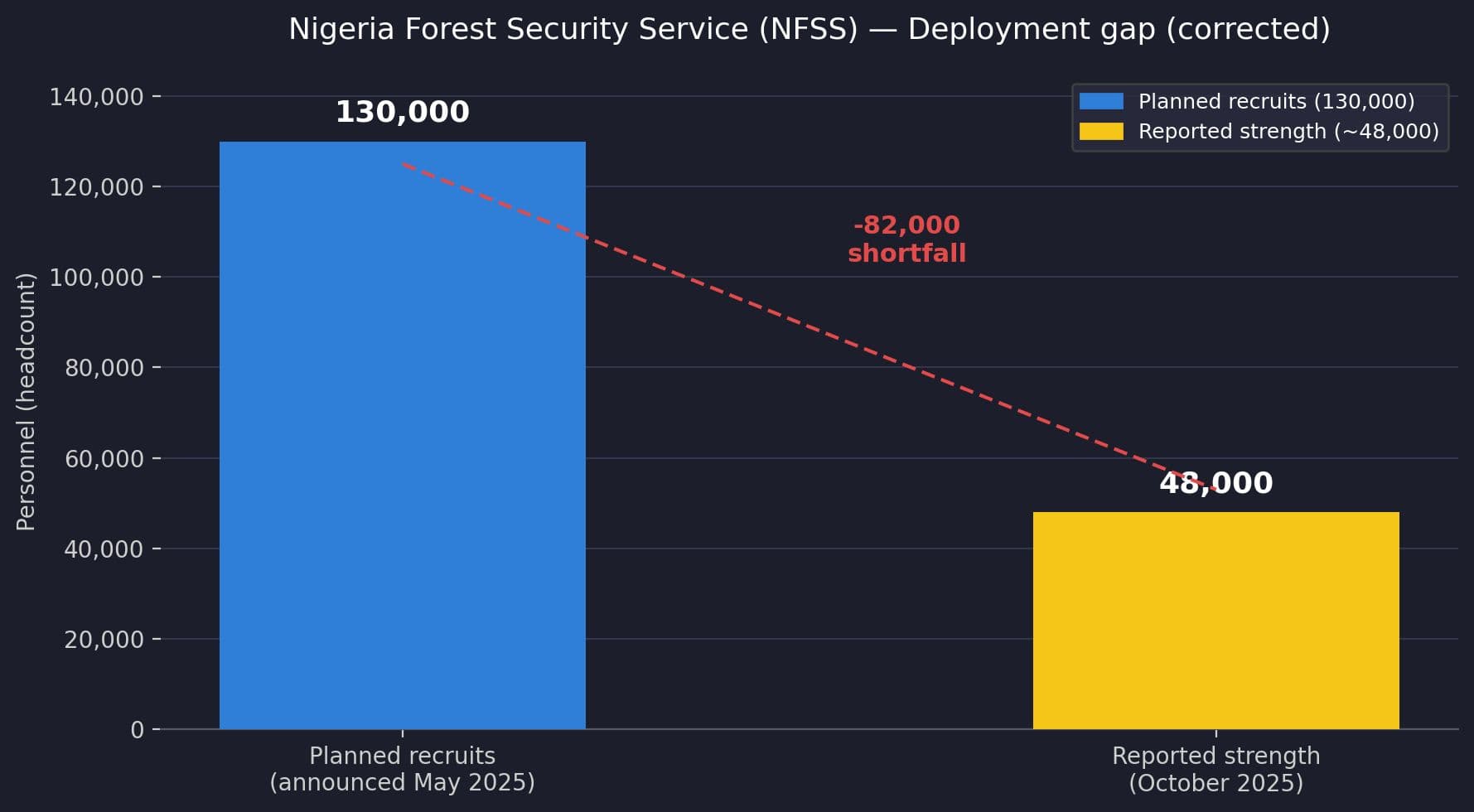
Fig. 2
The gap between aspiration and deployment tells only part of the story. Security sources and community leaders in the South-West describe guards who patrol without functional communication devices, who lack vehicle support in reserves the size of small counties, and who have no clear rules of engagement for confronting armed men. Omo Forest Reserve in Ogun and Ondo states covers 130,500 hectares of some of the most biologically rich land in West Africa and some of the least monitored.
“A guard in the bush without a radio is just a man with a stick. You cannot ask unarmed civilians to hold a line that infantry units are struggling with.”
The federal government has not published any detailed breakdown of NFSS equipment standards, salary scales, or rules of engagement. Requests for comment from the Federal Ministry of Environment on deployment gaps and guard welfare went unanswered at the time of publication.
THE UNSUNG HEROES
Behind the aggregate numbers, 207 killed in Kwara, 816 pupils abducted nationally, and 2,266 dead across all bandit-related violence in the first half of 2025 alone, is a category of loss that receives almost no formal accounting: the forest guards themselves.
Since the NFSS was formalised in 2021, at least 60 guards and community protectors have been killed in documented attacks at forest outposts and patrol routes, according to open-source incident reports compiled from state police statements, Premium Times, The Guardian Nigeria, and the Nigeria Security Tracker.
Forest guard and community protector fatalities per documented incident, Nigeria 2022–2026. Red bars denote NFSS-designated guards. Pre-2024 incidents involved mixed vigilante-guard formations. Source: open-source incident reports
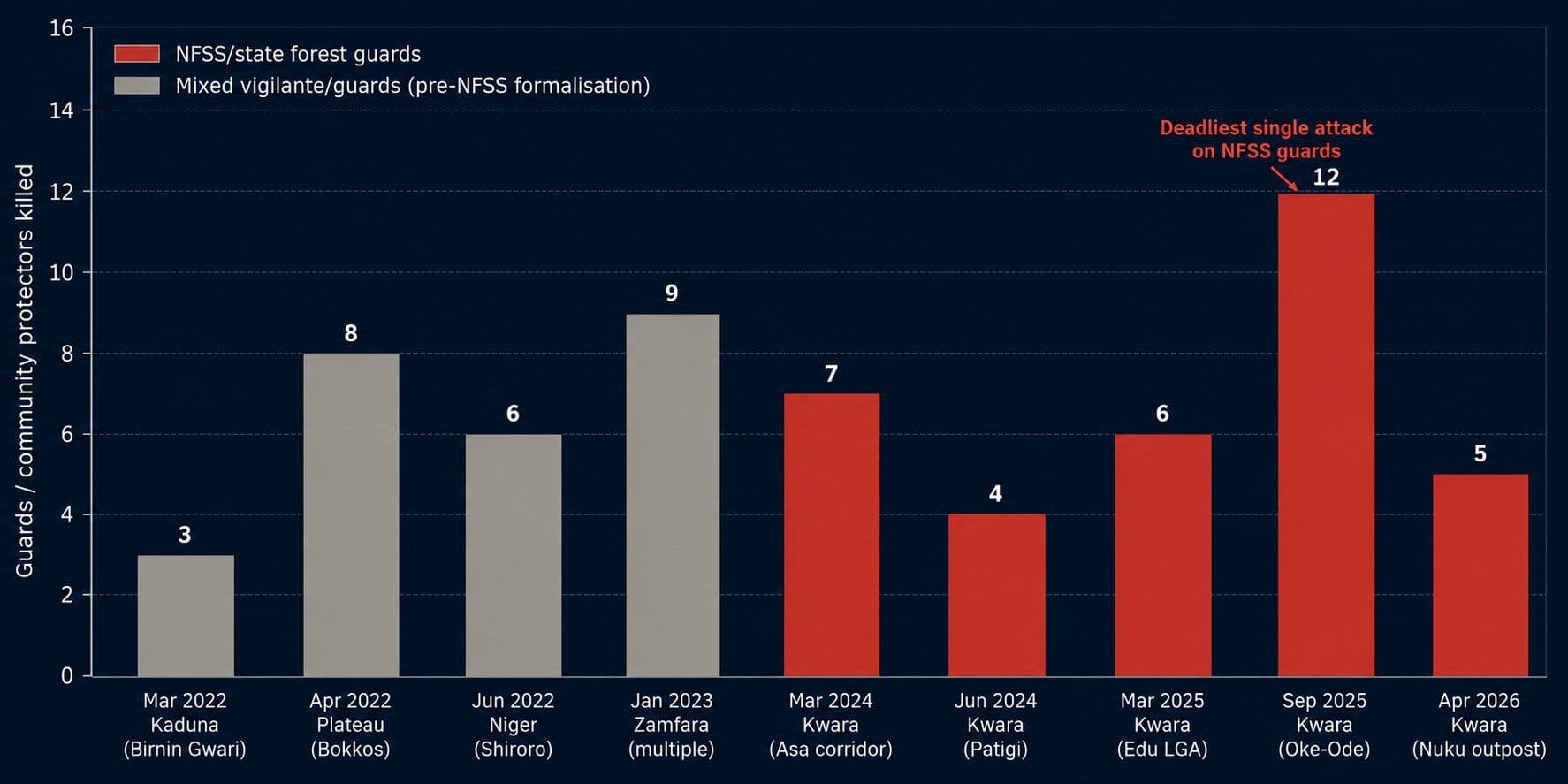
Fig. 3
The September 2025 attack at Oke-Ode in Kwara's Ifelodun LGA, in which at least 12 guards were killed by armed gunmen who invaded the town, shooting sporadically, according to police, is the deadliest single incident against the service on record. Four others were wounded. Local sources put the total toll at between 12 and 15, including prominent community figures. At least four members of the same family were abducted.
The April 2026 attack on the Nuku outpost in Kwara's Kaiama LGA, in which five guards were killed and two kidnapped, hours after terrorists paraded 176 abducted residents from a neighboring community, shows the pattern continuing into the current year. The outpost was part of Kwara's community security initiative launched in 2023. The guards had basic firearms and motorcycles. The attackers arrived in coordinated formation before 3 A.M
The NFSS's Commander General told reporters in early 2025 that the service had lost personnel in the line of duty but declined to give a cumulative figure. The National Assembly's defence committee has not published a breakdown of NFSS casualties.
No equivalent of the soldier's death-in-service benefit applies automatically to guards whose legal status under the pending NFSS bill, awaiting presidential assent as of publication, remains unresolved.
THE IGNORED TRENDS
Nigeria recorded 22 separate school attacks between January 2023 and late 2025, with more than 816 pupils abducted. The list runs through Zamfara, Katsina, Niger, and Kaduna, then, in November 2025, spreads to four states simultaneously, with 402 students and teachers seized in a single week. Each time, the public debate centred on ransom, negotiation, and the immediate release. Each time, less attention was paid to the corridor that those attacks revealed.
Organisations tracking Nigerian conflict data have warned for over a year that bandit expansion into the Middle Belt and Southwest was not a question of intent but logistics.
The forests, they argued, are highways. Without physical presence, genuine patrols, functional intelligence networks, and community informants who trust the state enough to share information, the reserves become staging grounds.
Nigeria's forest security architecture was designed primarily around conservation, not counter-insurgency. The NFSS inherited a regulatory mandate, stopping logging and enforcing reserve boundaries, and was asked, almost as an afterthought, to confront armed groups that would not have been out of place in a regional conflict assessment.
The training pipeline was not built for that mission. The equipment budget was not written for that threat.
Àkànní Olúwaségún Michael
Àkànní Olúwaségún Michael is a freelance journalist based in Nigeria and a student of Communication and Language Arts. He reports on migration, governance, security, development, and other underreported issues affecting African communities. His work centers on human-centered storytelling and public-interest journalism, with a focus on bringing local stories to global audiences through in-depth reporting and research
comments
No comments yet