
Niger Coup: Assessing the State of the Republic Three Years On
by

On 26 July 2023, Niger's armed forces, led by General Abdourahamane Tchiani, overthrew President Mohamed Bazoum, citing the country's deteriorating security environment, economic mismanagement, and governance failures as justification for the coup. Three years later, the military government remains firmly in power, while President Bazoum, his wife and immediate families continue to be held in detention. Niger's coup formed part of a broader wave of military takeovers that reshaped the Sahel beginning in 2020, accelerating the region's democratic backsliding and altering its political landscape. Since then, military governments have become increasingly entrenched across parts of West Africa, with the number of junta-led states continuing to grow as successive coups challenged the region's constitutional order.
Like the military governments in neighbouring Sahelian states, Niger's junta presented itself as a corrective to years of civilian misrule, promising to restore security, revive the economy, and improve governance. Those pledges resonated with many Nigeriens who had grown increasingly frustrated by persistent insecurity, economic hardship, and declining confidence in state institutions. Three years on, however, the junta's record presents a more complicated picture. While the authorities have consolidated political control, the country's security environment remains fragile, with militant violence continuing to threaten large parts of the country. The limited progress in restoring security has also constrained broader economic recovery and governance reforms, underscoring the interconnected nature of Niger's political, security, and development challenges.
This article assesses the state of Niger three years after the coup, examining the junta's performance across security, governance, and economic management. It also considers the country's likely trajectory and the domestic, regional, and international actors that will shape Niger's future in the years ahead
Political Consolidation
Over the past three years, the military junta has steadily tightened its grip on power by dismantling key democratic institutions, shrinking civic space, and suppressing political opposition and civil society. Instead of laying the groundwork for a return to constitutional rule, the regime has focused on removing real and perceived threats to its authority. The continued detention of former President Mohamed Bazoum and his family remains the clearest symbol of that approach, but it is only one example. The terrorism-related prosecution of prominent human rights activist Moussa Tchangari has further fuelled concerns that the judicial system is being used to silence critics rather than uphold the rule of law.
The crackdown has not been confined to Niger. Human Rights Watch reports that at least 18 Nigerien opposition figures living in exile have been stripped of their nationality after publicly criticising the regime, signalling that the junta is willing to pursue its opponents beyond the country's borders. At home, the authorities have dissolved trade unions, restricted the activities of civil society organisations, and detained activists, steadily narrowing the space for political participation. They have also cut ties with several international humanitarian organisations, including the International Committee of the Red Cross (ICRC), disrupting humanitarian operations and reducing assistance to communities already affected by conflict.
Collectively, these developments point to a deliberate effort to consolidate power rather than manage a temporary transition. Niger, once regarded as one of the Sahel's strongest democratic performers, has seen a steady erosion of political freedoms and democratic institutions since the coup. The absence of a credible transition plan has only deepened those concerns. Although the junta has proposed extending the transition period until 2030, there is little certainty that the timeline will culminate in a genuine return to civilian rule.
A Worsening Security Environment
Security was the central justification for the July 2023 coup, yet it remains the junta's weakest area of performance. Instead of reversing the country's deteriorating security situation, the military has found itself confronting an increasingly complex threat environment. Jihadist organisations continue to expand their operations, while anti-junta armed groups have opened another front against the government.
Jama'at Nusrat al-Islam wal-Muslimin (JNIM) and the Islamic State Sahel Province (ISSP) have sustained attacks on military positions, particularly in the Tillabéri region, which remains the epicentre of Niger's insurgency. At the same time, violence has spread into areas that were previously less exposed, including Dosso and Gaya. The expansion of militant activity into these regions reflects the growing operational reach of armed groups and the state's continued struggle to contain the conflict.
The deterioration has been compounded by weakened regional cooperation. The suspension of security coordination between Niger and Nigeria following the coup has reduced intelligence sharing and disrupted joint border operations, creating opportunities for armed groups to exploit the porous frontier. The Dosso region has also become an arena for intensified rivalry between JNIM and ISSP, while diminished cross-border cooperation has facilitated the movement of fighters and contributed to the gradual spillover of insecurity into northern Nigeria.
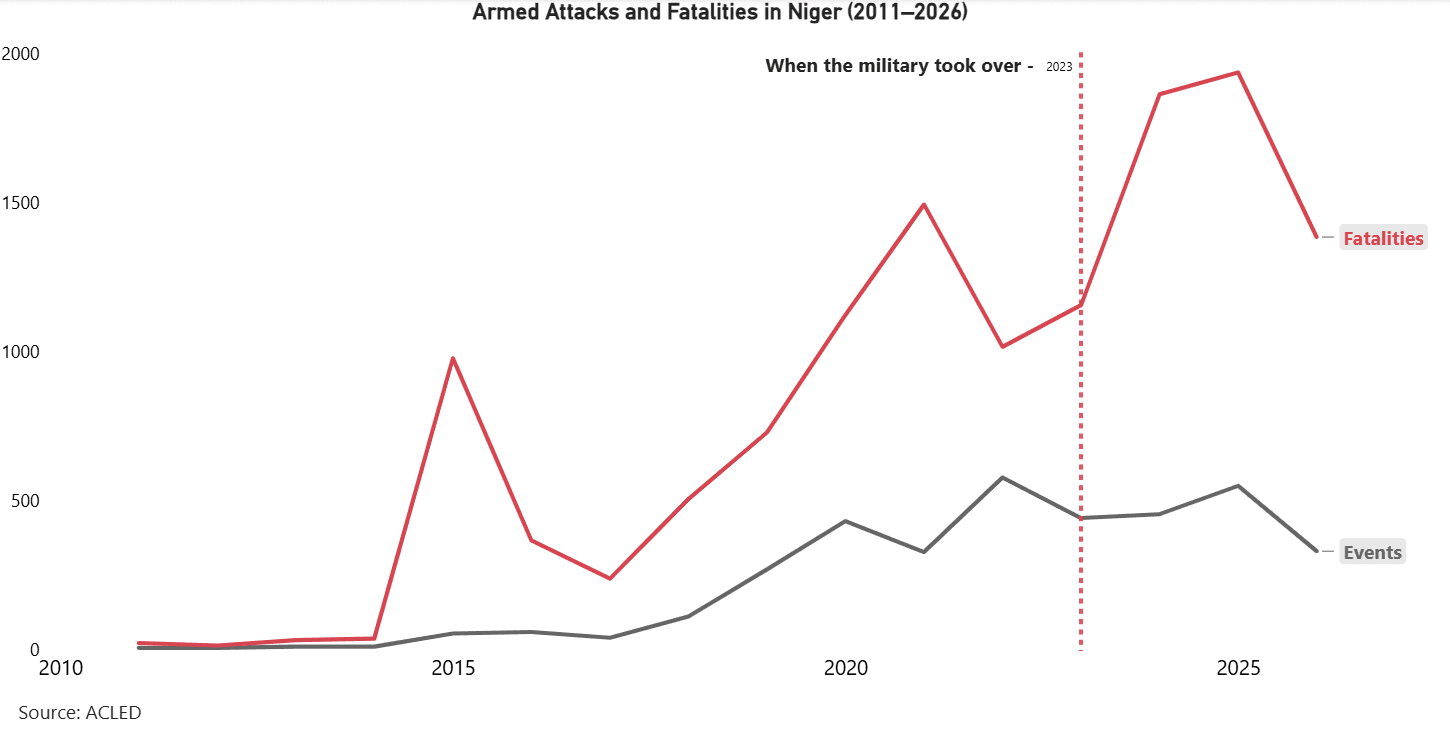
The data reinforces the scale of the challenge. According to ACLED, Niger recorded more than 1,200 conflict-related fatalities in 2025. In the 2026 Global Terrorism Index, the country ranked as the third most terrorism-affected state in the world, a sharp decline from the position it occupied before the coup. At the same time, the junta is facing a new security challenge beyond the jihadist insurgency. Anti-government armed groups, particularly the Patriotic Liberation Front (FPL), have carried out attacks on strategic economic infrastructure, including the Niger-Benin crude oil pipeline, in an effort to weaken the regime economically. The emergence of an organised armed resistance alongside an already active jihadist insurgency has placed additional pressure on an overstretched security apparatus and further complicated Niger's security outlook.
Economic Performance
Economically, Niger has performed better than many expected, despite the severe shocks that followed the July 2023 coup. The immediate aftermath was marked by the closure of borders with Nigeria and Benin, financial and commercial sanctions imposed by ECOWAS, and the suspension of electricity exports from Nigeria, which previously supplied about 70 percent of Niger's domestic electricity needs. Those measures disrupted commercial activities, affected public healthcare and industrial production, and, alongside the freezing of sovereign accounts and the suspension of external budget support, constrained the government's ability to service its public debt.
Despite these early setbacks, the economy rebounded, driven largely by oil production and agricultural output. Real GDP growth accelerated to between 8.3 and 8.4 percent in 2024 before moderating to a still robust 7.0 percent in 2025. A major driver of that recovery was the operationalisation of the 2,000-kilometre crude oil export pipeline developed in partnership with the China National Petroleum Corporation (CNPC). Increased oil production and exports generated much-needed government revenue and strengthened foreign exchange earnings at a time when the country faced growing external pressure.
Macroeconomic conditions also improved. Food inflation, which surged in late 2023 and early 2024, eased during 2025 as agricultural production recovered, contributing to a modest decline in the national poverty rate from 51 percent to 49 percent. The junta also pursued a more assertive resource nationalism agenda. One of its most consequential decisions was the revocation of the operating licence of the French state-owned mining company Orano and the government's takeover of operational control of the SOMAIR uranium mine in 2025. While some of these policies were viewed as controversial, they also strengthened state control over strategic resources and contributed to the country's economic stabilisation.
Foreign Relations and Geopolitical Alignment
Niger's foreign policy has undergone a significant realignment since the coup. Relations with its immediate neighbours remain strained following its withdrawal from ECOWAS and the formation of the Alliance of Sahel States (AES) alongside Mali and Burkina Faso. The deterioration in ties with Nigeria and Benin has complicated cooperation on border security, intelligence sharing and cross-border trade, all of which have had wider implications for regional stability.
There are signs that some of these relationships may gradually improve. Niger and Benin have expressed interest in restoring cooperation and reopening their shared border, although it remains unclear how quickly that rapprochement will materialise. Relations with Nigeria, however, continue to be difficult, and that remains one of the biggest obstacles to effective regional security cooperation.
The junta has also strengthened relations with Algeria, expanding cooperation in areas such as defence and education despite broader tensions between Algeria and the AES bloc. Beyond the region, Niger has deepened its security partnership with Russia following the collapse of its military relationship with Western partners after the coup. Although Russia's footprint remains smaller than in Mali or Burkina Faso, the Africa Corps has supplied military instructors, air defence systems and tactical drones. Russian personnel have also been involved in protecting senior government officials and strategic infrastructure, including Air Base 101 in Niamey.
China has remained one of Niger's most important economic partners, particularly through its investment in the Agadem oil project and broader energy infrastructure. More recently, however, the junta has adopted a more pragmatic diplomatic approach. General Abdourahamane Tchiani's visits to Algeria and Turkey, including his first trip outside Africa, point to an effort to diversify Niger's international partnerships. The junta has also shown greater willingness to engage the United States, with reports indicating renewed security cooperation, including the provision of military equipment to Nigerien forces. These developments suggest that the regime is gradually moving away from the isolationist posture that characterised the early months after the coup and towards a more flexible foreign policy based on strategic interests rather than ideological alignment.
Outlook
Three years after the coup, the junta's record presents a mixed picture. Politically, it has consolidated power while offering little indication of a credible path back to civilian rule. Security has continued to deteriorate, with insurgent violence expanding and anti-junta armed groups opening another front against the government. The economy, by contrast, has proved more resilient than many anticipated, supported by rising oil exports, stronger agricultural output and greater state control over strategic resources.
Looking ahead, the military government is likely to remain in power for the foreseeable future. Even if a political transition eventually takes place, the current trajectory suggests the junta will seek to retain significant influence, potentially through an electoral process that preserves its dominance, as seen elsewhere in the region. Security cooperation with neighbouring states, particularly Nigeria and Benin, will remain a critical variable. Without stronger intelligence sharing and coordinated border operations, armed groups are likely to continue exploiting the gaps between national jurisdictions to sustain their activities.
The economic outlook is comparatively more favourable. Oil revenues and agricultural recovery should continue to support growth, provided global market conditions remain stable and major infrastructure remains secure. Diplomatically, Niger is also likely to continue broadening its external partnerships. Russia will remain an important security partner, while engaging with countries such as Turkey, Algeria, China and, to a more limited extent, the United States is likely to expand if current diplomatic efforts continue. Niger now sits at a pivotal moment. The choices made by the junta over the coming years will shape not only its own political future but also the country's wider security and geopolitical trajectory.
Adam Abass
Adam Abass is a graduate student of political science and international relations. His research focuses on Middle Eastern politics, counter-terrorism, peace, and security in Africa.
comments
No comments yet