
Unpacking the Priorities of the US-Nigeria Joint Working Group
by

In late 2025, Nigeria and the United States entered a period of diplomatic tension over allegations of Christian persecution in Nigeria and President Trump’s threat of military intervention in the country. The situation became increasingly strained, with the United States eventually designating Nigeria as a Country of Particular Concern (CPC).
Nigeria subsequently intensified its diplomatic efforts to manage the tension and prevent the relationship from deteriorating further. Relations began to improve following the US strike in Sokoto State in December, as both sides gradually moved away from unilateral rhetoric and towards a more cooperative approach focused on shared security interests. This shift eventually contributed to the establishment of the US-Nigeria Joint Working Group, a bilateral framework designed to strengthen cooperation on counter-terrorism, military intelligence sharing and religious freedom.
The working group has since held two sessions. The first was held in Nigeria and focused on establishing the framework for cooperation, while the second took place in Washington to review progress made during the subsequent months. According to the statement issued following the second session, discussions centred on three main priority: protecting Christian communities in Nigeria’s North-Central region, holding perpetrators of violence accountable through stronger judicial and security institutions, and strengthening military-to-military cooperation. This article unpacks these three priorities in greater depth and assesses the progress made so far, as well as the gaps that could affect the effectiveness of the working group moving forward.
Military-to-Military Cooperation
This stage appears to have seen the most significant collaboration and engagement between the two countries, and the military relationship has produced considerable operational outcomes for Nigerian forces on the ground. The US strike in Sokoto in December, the first known US strike on Nigerian soil, followed months of Intelligence, Surveillance, and Reconnaissance (ISR) activities conducted from the US airbase in Ghana. Following the first working group session, military relations between Nigeria and the United States also became more stable.
In January, the United States provided Nigeria with military logistics and supplies to support operations on the frontline. The following month, around 200 US military personnel arrived in Nigeria on advisory and non-combat duties. The United States also established a drone base in Bauchi, reportedly housing Reaper drones that have been used for surveillance of armed groups in the North-east and other parts of the country. US drone surveillance has reportedly covered parts of the North-east, as well as North-western states including Sokoto, Kebbi and Zamfara, and North-central areas such as Kwara.
The cooperation reached a significant operational level in May, when the United States and Nigeria conducted a joint operation that killed a senior ISWAP commander, Al-Mainuki, followed by another strike that reportedly killed 167 fighters and senior commanders of the group. These operations significantly disrupted ISWAP's leadership structure and weakened its operational capacity, with the effects still being felt within the group. In July, the United States announced a partial withdrawal of some of its personnel but indicated that close intelligence-sharing arrangements would continue.
The broader impact of this military engagement has been significant. Nigeria has maintained the operational tempo generated through the joint efforts, while pressure from the joint operations and subsequent Nigerian-led offensives appears to have temporarily disrupted ISWAP's movement of fighters from other countries into the Lake Chad Basin. It has also contributed to the surrender of senior commanders and technical specialists within the group.
However, the concentration of US intelligence and military assets in the North-east also exposes a major limitation. While the pressure has degraded ISWAP in its main operating environment, it may also have encouraged armed groups to redirect some activities towards other regions where security pressure is lower. Nigeria's threat landscape is not concentrated in one theatre. Sustaining military pressure in the North-east while leaving gaps in the North-west and North-central could therefore produce displacement rather than an overall reduction in the national threat.
Terrorism Legal Efforts
Nigeria has long struggled with the slow prosecution of terrorism-related cases, leaving thousands of suspects in detention facilities, in some cases for prolonged periods without trial. That dynamic appears to have changed significantly in 2026. Between January and July, Nigeria secured 865 terrorism convictions, with additional cases still before the courts. Some of the perpetrators of major terrorist attacks, including the Owo attack in Ondo State, were sentenced to death by hanging. Ansaru leaders arrested by the DSS during a coordinated operation were also sentenced to 20 years in prison.
The convictions form part of a broader mass-trial programme aimed at accelerating the prosecution of terrorism cases. The number recorded this year alone represents more than half of all terrorism-related convictions since the programme began. Importantly, the prosecutions have not focused exclusively on fighters and commanders. They have also reached deeper into the terrorism ecosystem, including financiers, couriers and logistics suppliers.
It is possible that US engagement has contributed to accelerating this process, particularly given the working group's focus on strengthening judicial and security institutions. However, Nigeria had already begun revisiting the prosecution of terrorism suspects before the bilateral framework was established. The DSS, for example, has released several individuals held over terrorism allegations where sufficient evidence was not available, with some reportedly receiving compensation. The recent increase in prosecutions should therefore be understood as part of a broader institutional shift within Nigeria's security and judicial system, although US engagement may have reinforced or accelerated that process.
Protecting Christian Communities
This is perhaps the most difficult priority to assess because the violence in the North-central states most frequently associated with religious persecution, particularly Plateau and Benue, is driven by a much wider combination of factors. Ethnic tensions, competition over farmland and grazing areas, communal disputes and broader livelihood pressures all contribute to the violence. ACLED data indicates that violence in the two states has shown a downward trend in 2026 compared with the exceptionally high levels recorded in 2025. However, violence has remained significant. Despite the presence of US personnel and assets in Nigeria, Plateau and Benue have continued to experience substantial levels of violence, with both states recording more than 100 fatalities in several months during the year.
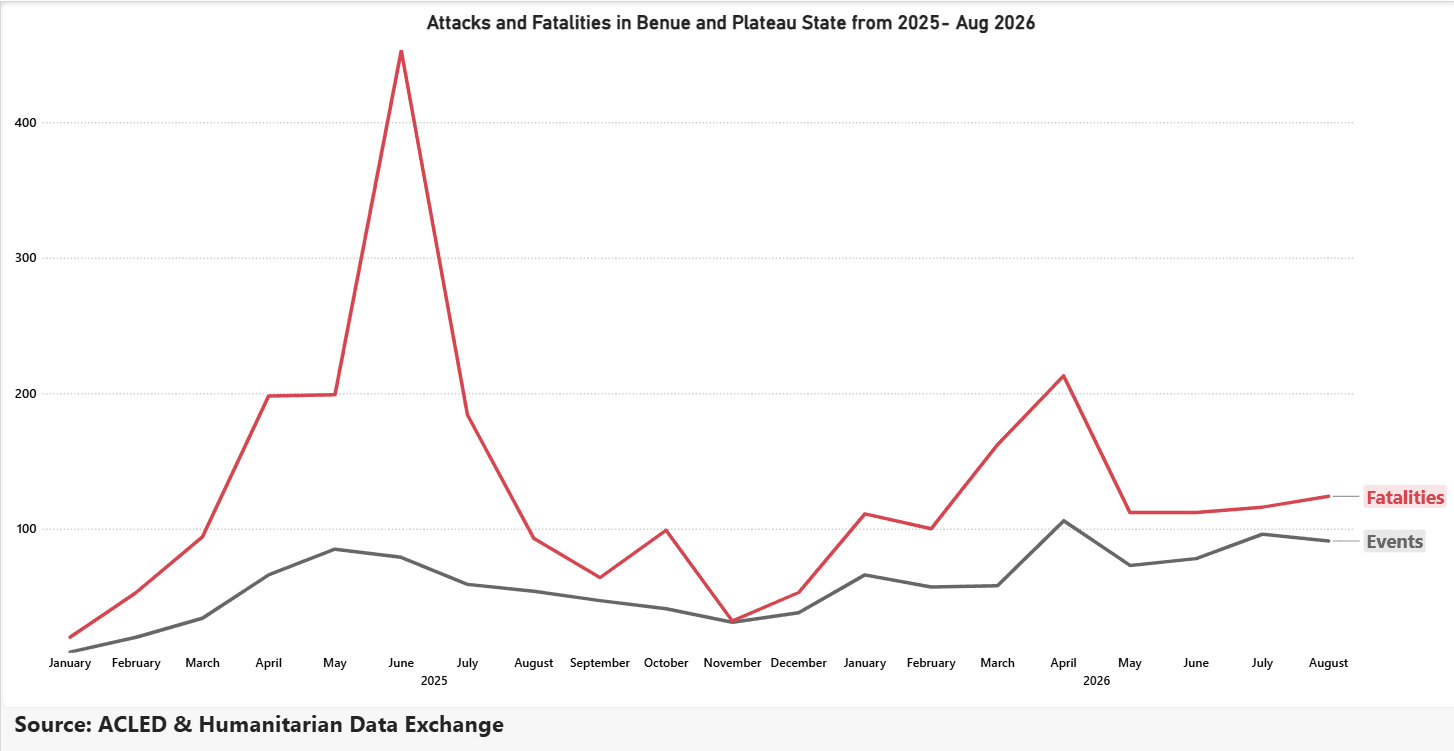
The current tension that has been reported in Plateau states in recent weeks, illustrates why narrow religious framing can be problematic. Tensions between predominantly Christian Berom and Mwaghavul communities and Muslim Fulani communities have continued to produce retaliatory attacks. Violence has targeted residents and livelihoods, including farmland and cattle, with attacks from one community often triggering reprisals from the other. This cycle of tit-for-tat violence has deep historical roots in disputes over land, farming and grazing. Religious identity adds an important political dimension, that malign actors often exploit these divisions to deepen tensions. However, reducing the conflict primarily to Christian persecution risks obscuring the wider drivers of violence and could make it more difficult to develop practical policies capable of addressing them.
The Gap
The priorities of the working group contain several policy gaps that could undermine its broader objectives and limit its impacts on the ground.
First, military-to-military cooperation has been heavily concentrated in the North-east, where US capabilities have helped target ISWAP's leadership and degrade its operational capacity. While this engagement has produced clear tactical gains, the heavy focus on one theatre may also create opportunities for armed groups to move or expand into areas where security pressure is lower. Nigeria's security environment is complex and multidimensional, with serious threats also present across the North-west and North-central regions. Future US-Nigeria military cooperation should therefore expand beyond the North-east and support intelligence, surveillance and operational capabilities in other high-risk theatres.
Second, the language of Christian protection could constrain efforts to address the deeper causes of violence in the Middle Belt. When a conflict driven by overlapping ethnic, political, territorial and livelihood factors is framed primarily through a religious lens, other important drivers risk being overlooked. The violence affects communities across religious and ethnic lines, and international support aimed at reducing it should reflect that reality. The working group should therefore focus on civilian protection broadly while recognising religious persecution where it is clearly established.
Finally, the announced and planned withdrawal of US troops raises questions about the future direction of military cooperation. The withdrawal does not necessarily mean the end of the partnership, as intelligence-sharing will reportedly continue, but it places greater responsibility on Nigeria to sustain the operational momentum generated during the period of closer US involvement.
Moving forward, US-Nigeria engagement should focus on maintaining intelligence-sharing arrangements, strengthening Nigerian military capabilities and expanding training and technical support. It should also provide greater support for community resilience, particularly in vulnerable areas where armed groups seek to exploit local grievances and economic vulnerabilities. For Nigeria, the priority should be to fill any capability gaps created by the US withdrawal, particularly in intelligence gathering and surveillance. At the same time, Nigeria needs to maintain pressure on ISWAP while redirecting sufficient resources towards the North-west and North-central, where the expansion of armed groups and communal violence continues to create new security challenges.
Afroangel Intel Admin
Afroangle Intel Admin
comments
No comments yet