
Can Nigeria’s Opposition Unite Before 2027?
by
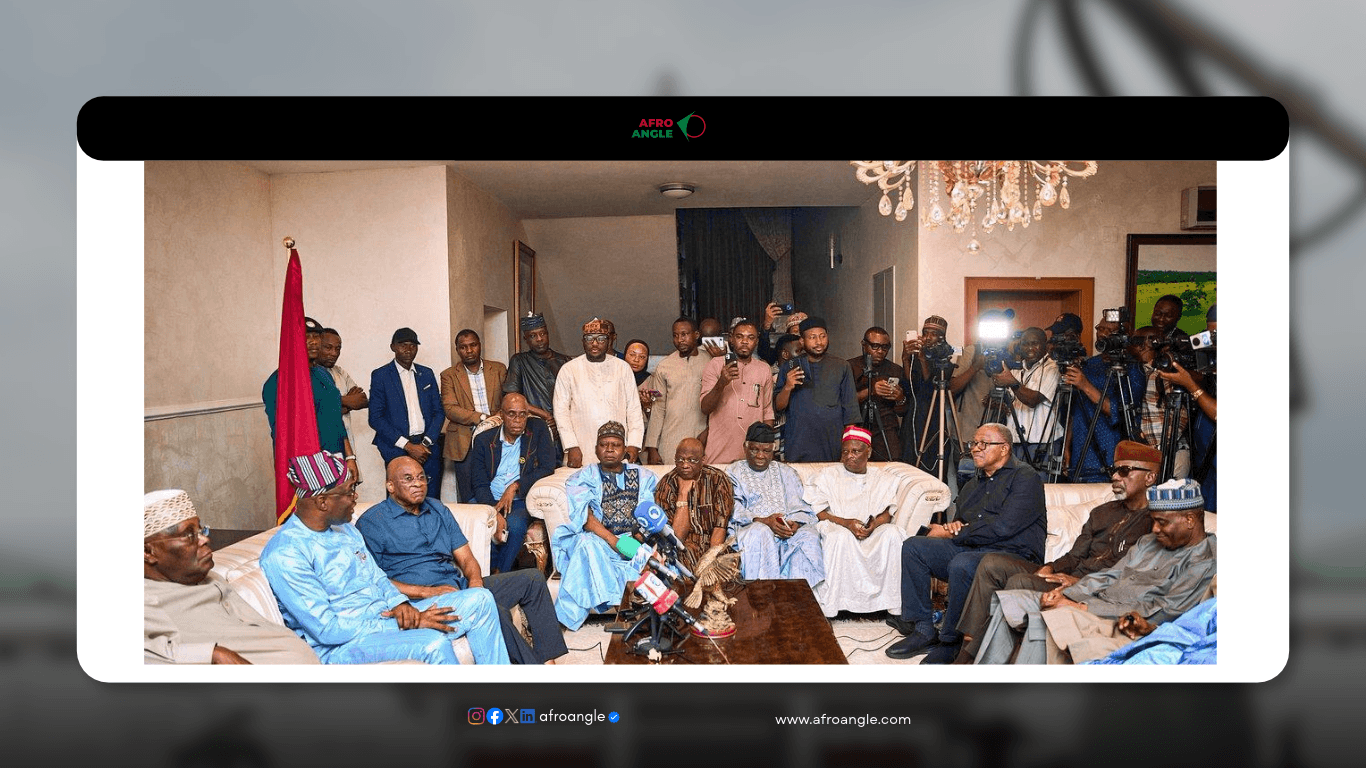
On November 30, Nigeria’s opposition leaders will gather in Abuja for another attempt to build a common political front against President Bola Tinubu and the ruling All Progressives Congress (APC) ahead of the 2027 presidential election.
The meeting, organised under the Coalition for Democracy, comes at a critical moment. With the election scheduled for January 16, 2027, the opposition is running out of time to resolve the disagreements that have repeatedly frustrated its attempts to challenge the ruling party collectively.
The coalition, comprising the African Democratic Congress (ADC), Allied Peoples Movement (APM), Nigeria Democratic Congress (NDC), a faction of the People’s Democratic Party (PDP), Peoples Redemption Party (PRP) and Social Democratic Party (SDP), is expected to sign a Covenant for Democratic Renewal and agree on a framework for political cooperation.
But the question that matters most remains unresolved: can these parties move beyond signing agreements and actually unite behind a common presidential candidate?
The urgency is difficult to ignore. Tinubu’s re-election campaign is already supported by an extensive political network, including more than 30 state governors who have publicly backed his second-term ambition. At the APC campaign rally in Ibadan on November 21, the President was accompanied by Vice-President Kashim Shettima, party leaders and 31 governors, according to reports.
For an opposition seeking to dislodge an incumbent with access to the machinery of federal power and considerable support across state governments, disunity could prove costly. The November 30 summit may therefore be one of its most important political tests before the election.
The lesson of 2023: numbers without unity
The argument for opposition unity is rooted largely in the outcome of the 2023 presidential election.
Tinubu defeated 17 other candidates with 8,794,726 votes. Atiku Abubakar, then the PDP candidate, secured 6,984,520 votes, while Peter Obi of the Labour Party polled 6,101,533. Rabiu Kwankwaso of the New Nigeria Peoples Party received 1,496,687 votes.
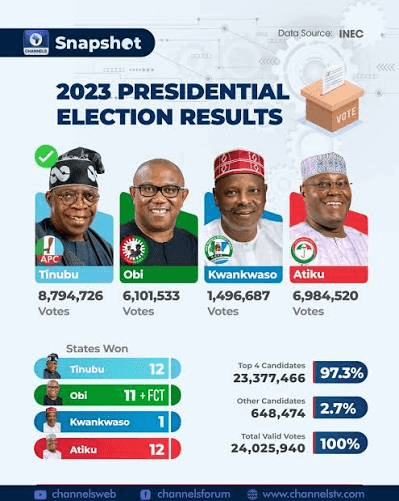
Combined, Atiku, Obi and Kwankwaso secured more than 14.5 million votes, which is substantially more than the 8.79 million recorded by Tinubu.
Those figures have become a recurring reference point for politicians advocating a united opposition. They suggest that the major opposition parties commanded considerable electoral support but failed to translate it into a collective challenge because they contested separately.
However, the arithmetic should not be mistaken for a guaranteed electoral outcome. Votes do not automatically transfer from one candidate to another simply because political parties reach an agreement. Atiku’s supporters may not necessarily vote for Obi, just as Obi’s supporters may not embrace Atiku or another candidate. Regional interests, political loyalties, candidate’s credibility and ideological differences would all influence the outcome.
Nevertheless, 2023 demonstrated that the opposition had substantial support to build upon. What it lacked was a strategy capable of bringing those different constituencies together.
That failure is precisely what the current coalition is attempting to address.
From Ibadan to Abuja: Has anything changed?
The November 30 summit is not the opposition’s first attempt to build a common platform.
Earlier this year, Oyo State Governor Seyi Makinde and the presidential candidate of the Allied Peoples Movement convened an opposition summit in Ibadan. The meeting brought together prominent opposition figures, including Atiku and Obi, around discussions about presenting a single candidate against the APC in 2027.
The initiative generated considerable expectations. It appeared to offer an opportunity for opposition politicians to put their differences aside and establish a framework for cooperation before the election approached.
But the optimism did not last.
As TheCable’s analysis of the collapse of the Ibadan convention observed, the political developments that followed exposed the contradictions within the gathering. Makinde’s presidential ambition became more pronounced, Atiku remained committed to pursuing the ADC ticket, while Obi and Kwankwaso moved towards the NDC.
Rather than consolidate the opposition, the disagreements exposed how difficult it would be to reconcile the ambitions of its leading figures.
The current Coalition for Democracy is, in many respects, another attempt to revive that conversation. Its six participating parties have reportedly developed documents addressing democratic renewal, political cooperation and a national reform programme.
The difference is that the November 30 meeting is expected to produce a more formal agreement, with party leaders and presidential candidates participating directly.
Yet the central challenge remains the same: who is prepared to step aside?
Three ambitions, one presidential seat
The political standing of Atiku, Obi and Makinde makes the negotiations particularly complicated.
Atiku, a former vice-president and veteran presidential candidate, remains one of the most established opposition figures in the country. Having emerged as the ADC presidential candidate, he has a political structure and a constituency that may be difficult to persuade to support another aspirant.
His position has been clear. Following speculation that he might withdraw in favour of another candidate, he rejected the suggestion, insisting that he remains in the race. His statement that he would neither ask anyone to step down for him nor step down for anyone captures the difficulty confronting the coalition.
Obi, on the other hand, represents a different political constituency. His performance in 2023 demonstrated his capacity to mobilise younger voters and attract support beyond the traditional political structures. His emergence as the NDC candidate alongside Kwankwaso has given the party a potentially formidable ticket, particularly in the South-East and parts of the North.
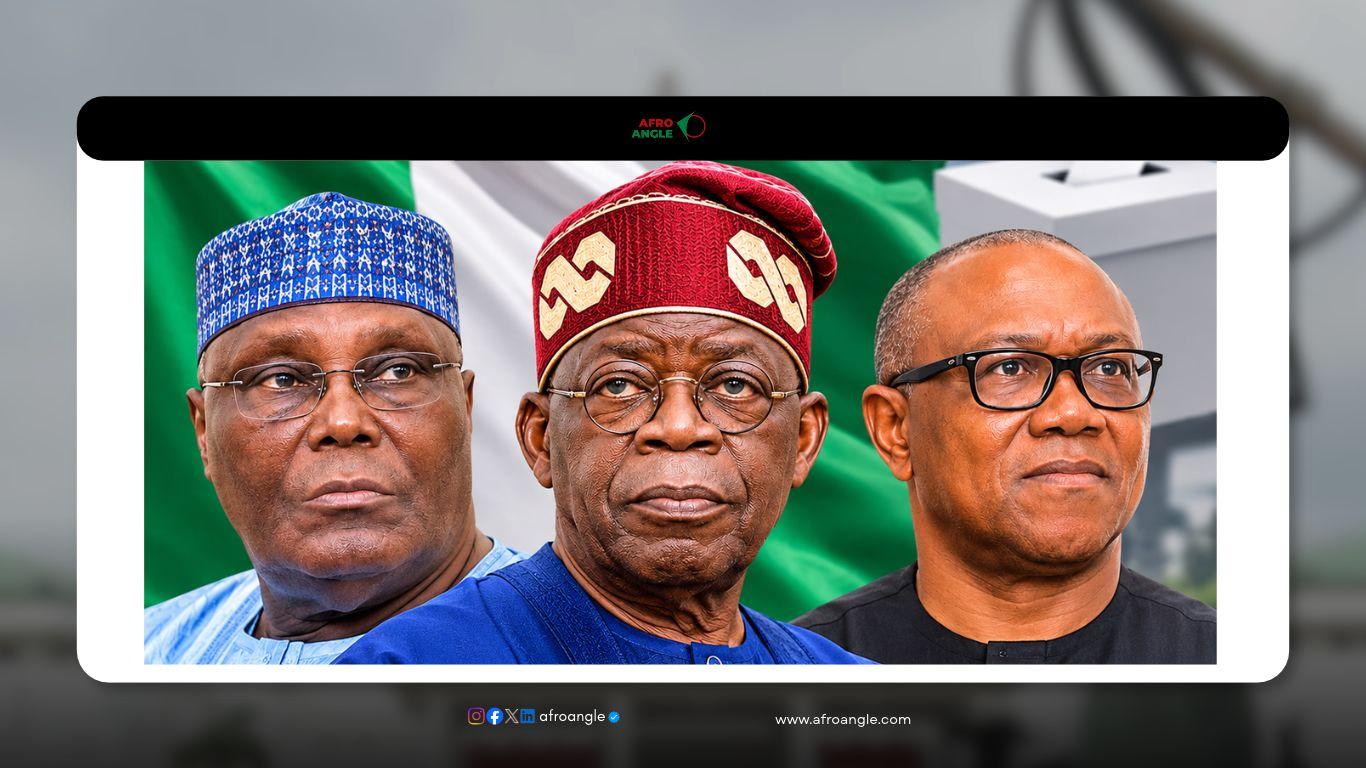
Some support groups previously associated with Atiku have already endorsed the Obi-Kwankwaso ticket, citing the need for opposition cooperation and regional considerations. However, endorsements by support groups are not the same as an agreement by the candidates and their political parties.
Makinde presents another dimension. As a sitting governor and the APM presidential candidate, he brings executive experience and a political base in the South-West. He has indicated that he is open to working with other opposition figures and believes the choice of a common candidate should be informed by manifestos, records in public office and public sentiment.
His willingness to consider another candidate is significant, but it does not settle the question of whether he would relinquish his own ambition.
The problem is therefore not a shortage of prominent opposition figures. It is the difficulty of convincing politicians who have invested political resources in their individual ambitions that the larger objective may require one of them to withdraw.
As an analyst had said in an interview with Premium Times, the candidates have already built structures and secured the confidence of their respective parties. He warned that agreeing to pursue a common candidate could trigger another disagreement over who should emerge.
That is the contradiction the coalition must confront.
Tinubu’s political advantage
While opposition leaders negotiate, Tinubu’s campaign is gathering momentum.
The President has the advantage of incumbency, a nationwide ruling-party structure and the backing of a significant number of governors. Reports indicate that more than 30 governors have endorsed his re-election, including some who belong to parties other than the APC.
This support matters beyond the optics of campaign rallies. Governors exercise considerable influence over party structures, grassroots mobilisation and political organisation within their states. Their involvement could give the President access to networks that an opposition candidate would have to work hard to build.
The APC’s campaign machinery is also already operating across the country. Its national campaign began in Kaduna in October, with Tinubu subsequently taking the campaign to several states.
However, political endorsements should not be confused with guaranteed votes. Governors cannot automatically deliver every voter in their states, and the President will still have to contend with public dissatisfaction over economic hardship, insecurity and the consequences of his administration’s policies.
The opposition can exploit those concerns, but only if it presents a credible alternative. A fragmented opposition may struggle to turn public dissatisfaction into a coordinated electoral challenge.
The legal clock is ticking
Beyond political disagreements, the coalition faces a legal challenge that could make the search for a common candidate more complicated.
Under Section 31 of the Electoral Act 2026, a candidate seeking to withdraw from an election must submit a written notice and sworn affidavit through the sponsoring political party to INEC not later than 90 days before the election.
For the January 16, 2027 presidential election, that deadline fell on October 18, 2026.
Section 33 also restricts political parties from changing or substituting nominated candidates, except in cases of death or withdrawal, subject to the provisions of the law. This means the parties cannot simply replace their existing presidential nominees through the ordinary withdrawal and substitution process at this stage.
A formal merger presents another difficulty. Section 81 of the Electoral Act requires political parties intending to merge to give INEC nine months’ notice and obtain the commission’s approval.
These provisions make it difficult for the opposition to create a new joint political platform and replace its existing candidates through the ordinary procedures.
However, this does not mean cooperation is impossible. The parties can retain their separate identities, coordinate campaigns, endorse one candidate and collaborate to protect their votes. Such an arrangement could provide a practical route towards a common political front without requiring a formal merger.
But there is an important distinction: an endorsement does not automatically remove other candidates from the ballot. Unless the legal requirements for withdrawal and substitution have been satisfied, multiple opposition candidates may still appear on the ballot even if their parties announce support for one another.
The coalition must therefore clarify what kind of unity it is pursuing. Is it seeking a single candidate on the ballot, or a political agreement in which some parties endorse another party’s candidate while retaining their own nominees?
The difference could determine whether the November 30 agreement produces an effective electoral arrangement or another political declaration.
More than signing a covenant
The November 30 meeting will be important, but its success should not be measured by the number of political leaders who attend or the documents they sign.
The opposition must demonstrate that it can resolve disagreements over leadership, candidate selection, regional considerations and the distribution of political influence. It must also develop a common message that speaks to Nigerians beyond the ambition of removing Tinubu.
There is a need for a credible alternative programme addressing the economy, insecurity, unemployment, education and governance. Nigerians must understand not only why the opposition wants to defeat the APC but also what it intends to do differently.
Equally important is the question of electoral organisation. The coalition has discussed pooling resources and coordinating polling agents to protect votes. This could be particularly useful for parties whose individual structures are not strong enough to cover polling units nationwide.
But such cooperation requires trust, clear responsibilities and a mechanism for resolving disagreements.
Ultimately, the opposition cannot expect voters to believe in its capacity to govern collectively if its leaders cannot demonstrate an ability to cooperate before the election.
The 2023 election showed that opposition votes, even when substantial, do not guarantee victory when divided among competing candidates. Tinubu’s growing political network makes the challenge even more formidable in 2027.
The November 30 summit offers another opportunity to correct that mistake. But the real test will come when the negotiations require political sacrifices rather than public declarations.
Can Atiku accept another candidate? Can Obi accommodate the interests of other opposition figures? Can Makinde and the remaining aspirants subordinate their ambitions to a collective decision? And can the parties agree on an arrangement that is both politically workable and legally defensible?
If they cannot answer these questions, the coalition may become another meeting where opposition leaders agree on the need for unity but return to their separate campaigns.
For Tinubu, that would be a considerable political advantage.
For Nigeria’s opposition, it could be another four years of wondering what might have been possible if they had chosen to fight together.
Olanshile Ogunrinu
Olanshile Ogunrinu is a Nigerian freelance journalist and graduate of Communication and Language Arts from the University of Ibadan. His works have appeared in notable local and international media platforms, where he reports on education, governance, politics, and human rights. He is interested in public-interest journalism, social justice, and accountability reporting, using storytelling to amplify underrepresented voices and contribute to informed public discourse.
comments
No comments yet