
ESCALATING RURAL INSECURITY ACROSS NORTHWEST NIGERIA
by
Listen to this article
ESCALATING RURAL INSECURITY ACROSS NORTHWEST NIGERIA
Security Situation Report : 01–08 March 2026
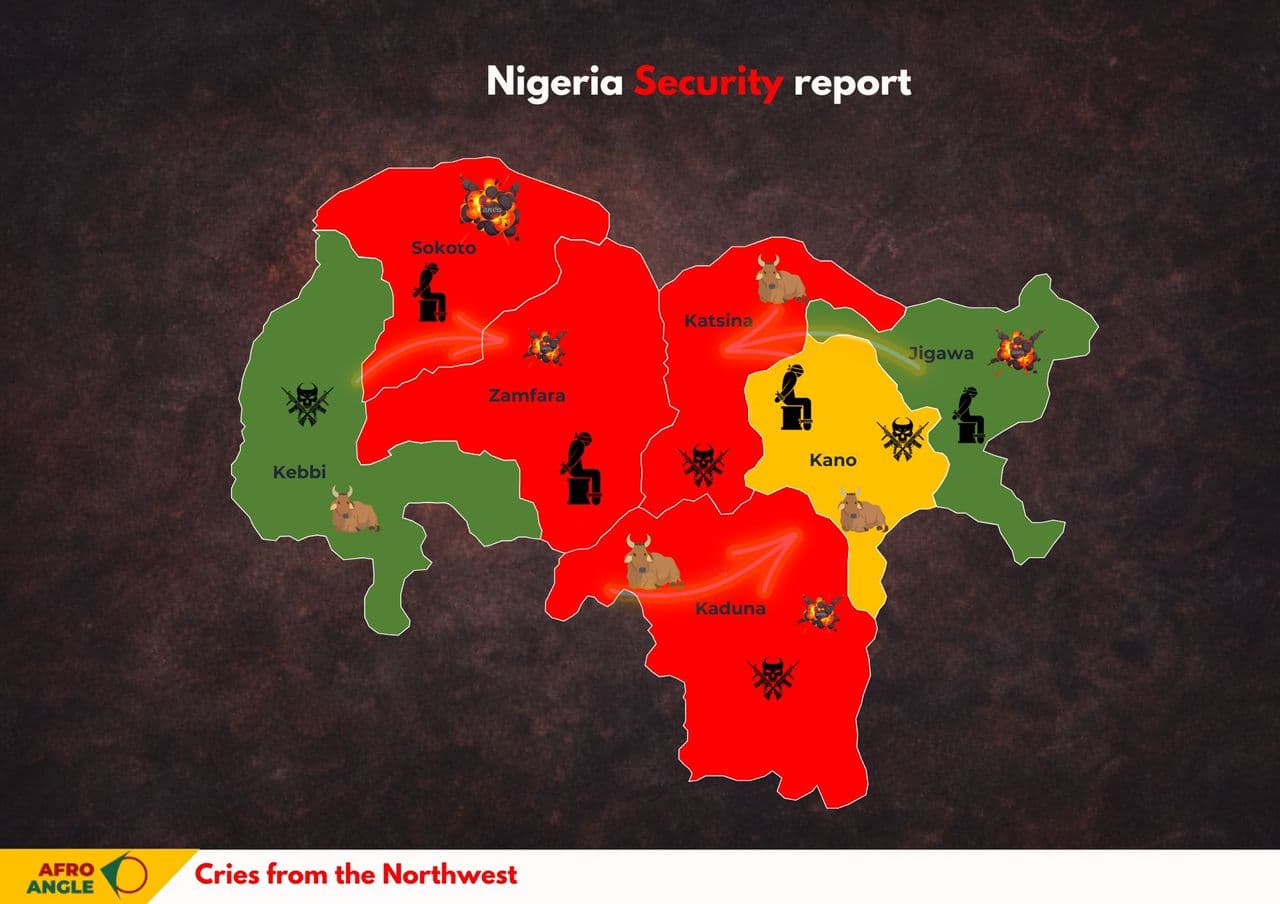
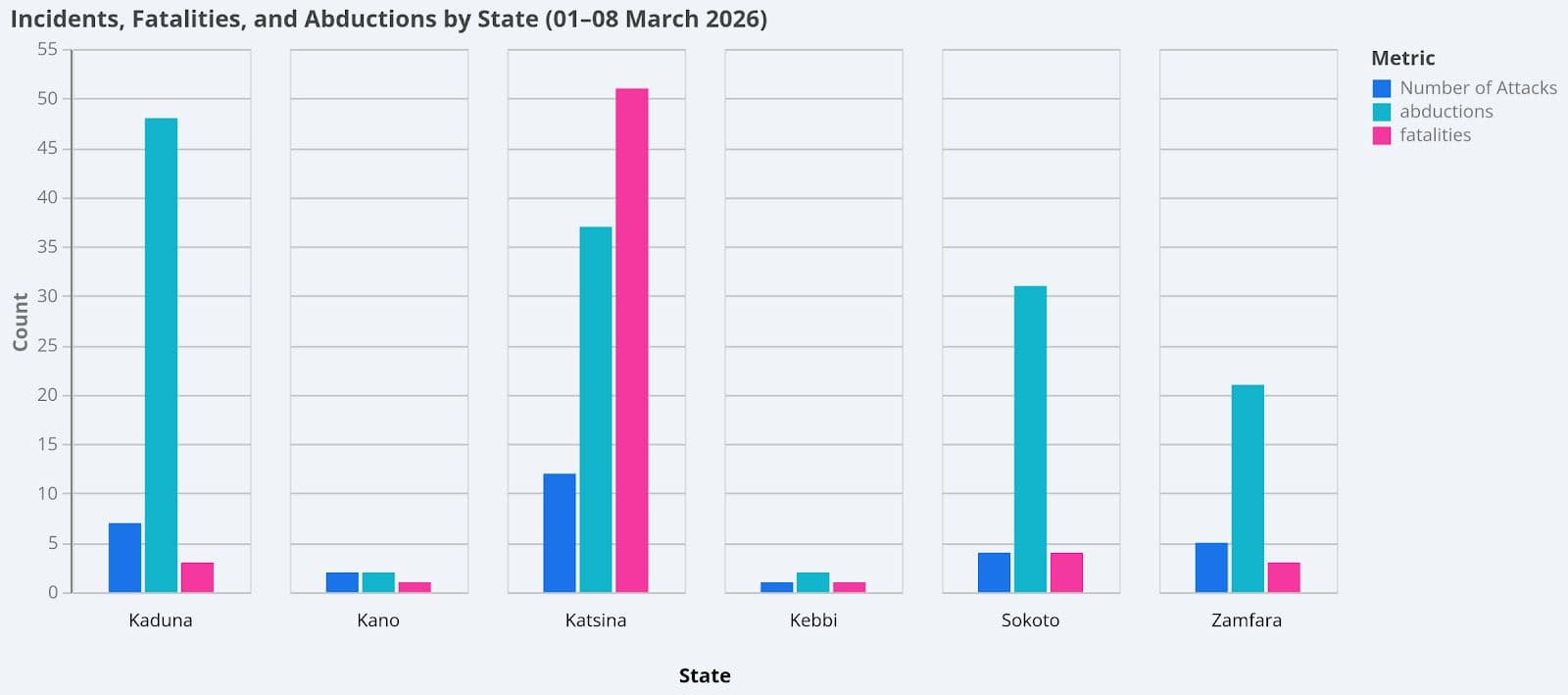
Between 01 and 08 March 2026, multiple incidents of armed banditry were recorded across Kaduna, Kano, Katsina, Kebbi, Sokoto and Zamfara states, reflecting continued instability across northwest Nigeria. The reporting period recorded community invasions, highway ambushes, mass abductions, livestock rustling and armed clashes between security forces and bandit groups.
Zamfara and Katsina states remain central operational hubs for armed bandit groups, with several attacks targeting rural settlements and transport corridors. Kaduna State also experienced repeated night raids involving large-scale abductions, particularly in Kachia, Kagarko and Giwa LGAs.
A major military operation in Dan-Musa LGA of Katsina State reportedly resulted in the neutralization of approximately 45 bandits, including senior commanders linked to the network of the notorious bandit leader Adamu Alieru. However, the operation resulted in the deaths of three soldiers, illustrating the continued intensity of armed confrontations between security forces and bandit groups.
Several incidents during the week show tactical adaptation among armed groups, including the use of deception tactics, highway kidnappings and the imposition of financial levies on rural communities. These patterns indicate the persistence of a ransom-driven criminal economy, as well as growing attempts by some bandit factions to exert economic control over rural populations.
Key Judgments
- Highway abductions are increasing, particularly along transport corridors in Zamfara and Katsina states.
- Mass night raids remain the dominant attack method, targeting vulnerable rural communities.
- Bandit factions are increasingly imposing financial levies and curfews, suggesting attempts to establish localized systems of control.
- Security force operations continue to disrupt some bandit networks, but armed groups retain mobility across state borders and forest corridors.
- Community vulnerability remains high, particularly in villages located near forest belts commonly used as bandit hideouts.
Key Incidents
Several incidents during the reporting period highlight both the scale and evolving tactics of armed bandit groups operating across the northwest region. One of the most significant developments occurred in Dan-Musa LGA of Katsina State, where Nigerian Army forces reportedly neutralized approximately 45 suspected bandits, including Kachalla Alti, the nephew and second-in-command of the notorious bandit leader Adamu Alieru, alongside another senior fighter known as Damale. However, the operation resulted in the deaths of Captain Paul Hassan and two other soldiers.
Along the Gusau-Dan Sadau road in Maru LGA of Zamfara State, bandits established a road blockade, opened fire on travellers and abducted at least 20 civilians, injuring 10 others. Similarly, on the Faskari–Kankara road in Katsina State, armed groups abducted at least twenty travellers during a roadside attack. These attacks highlight the vulnerability of traveling along the highways in the Northwest Region.
In Kaduna State, repeated night raids targeted rural settlements. In Gidan Tama, Kachia LGA, at least 10 civilians including an infant were abducted during a community invasion, while another attack in Janjala, Kagarko LGA, resulted in the abduction of at least fifteen residents.
In Sokoto State, attackers demonstrated increasing operational adaptation. In Mallamawa community of Rabah LGA, bandits reportedly disguised themselves in hijabs as women, enabling them to infiltrate the community before launching an attack that killed one civilian and abducted at least twenty residents.
Meanwhile, bandits continue to impose economic pressure on rural populations as armed groups reportedly imposed a ₦30 million levy and curfew on residents in Bilbis village, Tsafe LGA of Zamfara State, showing a growing pattern of coercive taxation.
Trends
Expansion of Highway Kidnappings
- Highway ambushes are becoming increasingly common across northwest Nigeria. Several incidents during the reporting period involved armed groups blocking rural transport routes to abduct travellers and disrupt civilian movement. Transport corridors such as the Faskari–Kankara road in Katsina State and the Gusau–Dan Sadau corridor in Zamfara State have emerged as high-risk zones. These attacks allow bandit groups to quickly capture large numbers of hostages while minimizing the risks associated with prolonged community raids.
Ransom Economy and Target Selection
- Kidnapping for ransom remains the primary economic driver of banditry across the northwest region. Many attacks recorded during the week targeted individuals believed to have financial or social value within their communities. Religious leaders and respected community members are increasingly among those targeted. In Kankara LGA, the killing of Malam Surajo, a respected community member, and the abduction of residents including a mosque leader illustrate how armed groups continue to exploit community structures to pressure families into ransom negotiations.
Bandit Governance and Coercive Taxation
- The imposition of financial levies on communities suggests that some bandit factions are moving toward systems of localized control. The reported ₦30 million demand imposed on residents of Bilbis village in Tsafe LGA reflects a pattern in which communities located near bandit-controlled forest areas are compelled to pay protection levies or face repeated attacks. These dynamics highlight the emergence of parallel authority structures in areas with limited state presence.
Community Impact
Beyond the immediate casualties and abductions, the continued pattern of armed attacks across northwest Nigeria is producing significant social and economic disruption. Fear of attacks has forced many residents to limit travel to markets and nearby towns, disrupting rural trade networks. Farmers in several affected communities have also reported difficulty accessing farmlands located near forest belts used by armed groups as operational bases. Additionally, livestock rustling continues to undermine rural wealth and food security, while repeated abductions have created psychological trauma and economic strain for affected families, many of whom must raise large ransom payments to secure the release of relatives.
Without sustained security stabilization and disruption of ransom financing networks, these patterns are likely to continue affecting community resilience, agricultural productivity and local economic activity across the northwest region.
Salihu Abdulmumini Bamle
Salihu Abdulmumini Bamle is a Security and Crisis Management specialist and conflict journalist covering insecurity and humanitarian crises in the Northwest Nigeria.
comments
No comments yet