
Targeted Military Operations Gain Decisive Momentum in the Northern Region
by
Listen to this article
North-west Nigeria: Security Situation Report (April 19–25, 2026)
Introduction:
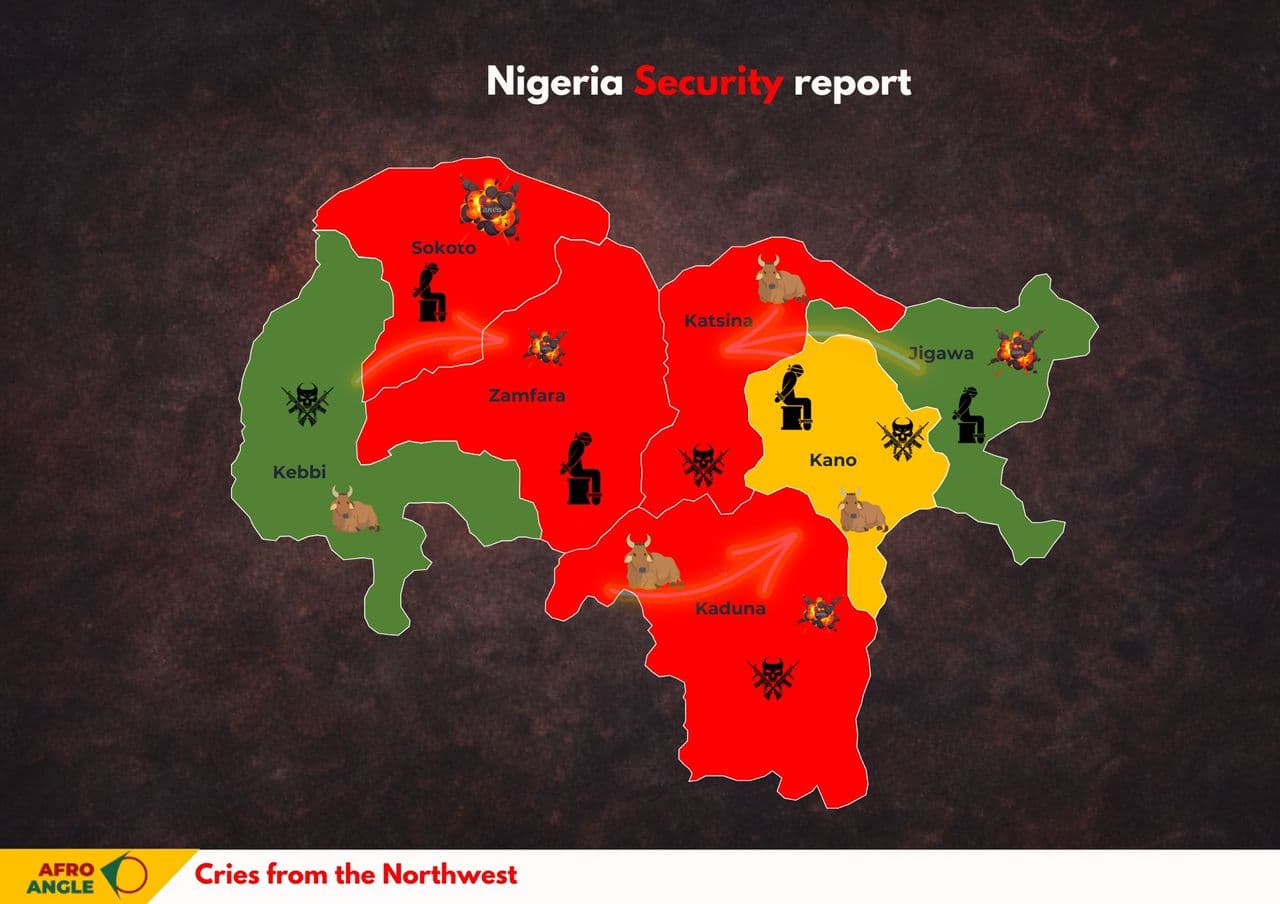
For the first time since February 2026, the North-west has experienced a significant decline in attacks, signaling a potential shift in the security environment. This reduction is largely attributed to a decrease in bandit activity, likely driven by sustained military offensives. During the reporting period of April 19–25, the region saw a widespread reduction in violent incidents; however, this does not imply a total absence of conflict. Violent attacks were still recorded across Katsina, Zamfara, Sokoto, and Kebbi, involving bandit raids on communities that led to cattle rustling, the looting of property, and the abduction of civilians, including children. Notably, bandit incursions during this period were met with fierce resistance from local populations; in one such incident in Achida, Wurno Local Government Area of Sokoto State, a bandit was apprehended and subsequently killed by the community.
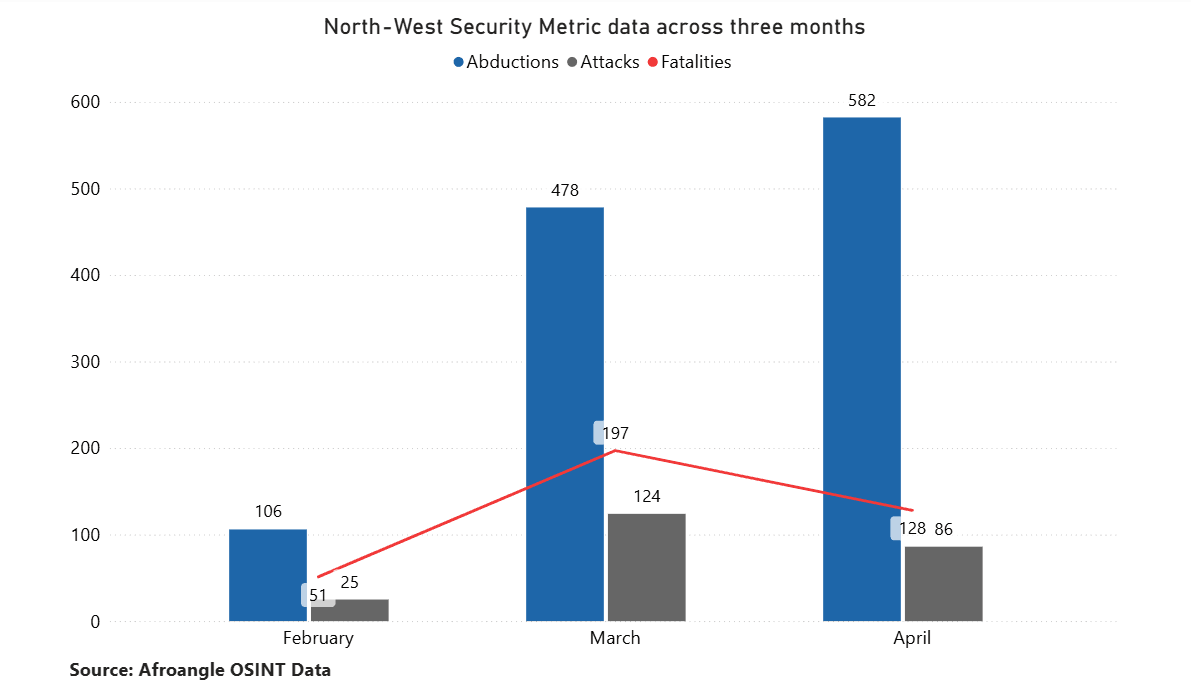
The chart shows a sharp escalation in North-West incidents between February and April, with abductions rising dramatically from 106 in February to 478 in March and 582 in April. Fatalities also increased heavily from 51 in February to 197 in March, before dropping to 128 in April. Attacks followed a similar pattern, increasing from 25 in February to 124 in March, then declining to 86 in April.
While the North-west enjoyed a relative decline in violence this week, intensified and coordinated military operations continue in the North-east. A combination of strategic airstrikes on insurgent strongholds and ground-troop assaults has dealt severe blows to these groups, significantly degrading their operational capabilities. One such assault resulted in the elimination of a senior ISWAP commander.
Operational theaters across the North are experiencing a sustained military offensive that is forcing insurgent and armed groups to cave in and concerns remain regarding the sustainability of these assaults. The primary challenge persists in translating these tactical and operational successes into long-term, enduring stability for the northern region.
Week in Review
A comparative analysis of this reporting period against the previous week indicates reduction in overall activity, but a slight increase in fatalities. Recorded incidents declined to 15 from 29, representing a 48% decline in operational tempo of attacks. Abduction also maintained a similar decline, with reduction from 172 to 28, reflecting a 82% decline, and suggesting a significant reduction in overall armed groups activity in the region. However, fatalities maintained a slight increase from 21 to 24, suggesting a 14% increase from the previous week, which means that while there’s a drop in attacks and abduction, these attacks were able to be converted into lethal activity, suggesting the growing lethality of the situation. Regionally, security metrics across the north-west were spread between Zamfara and Sokoto, where Zamfara state leads the region with 16 fatalities, and 6 attacks, while sokoto on the other hand, lead the with 22 abduction sokoto. This shows how security situations are spread disproportionately across the region.
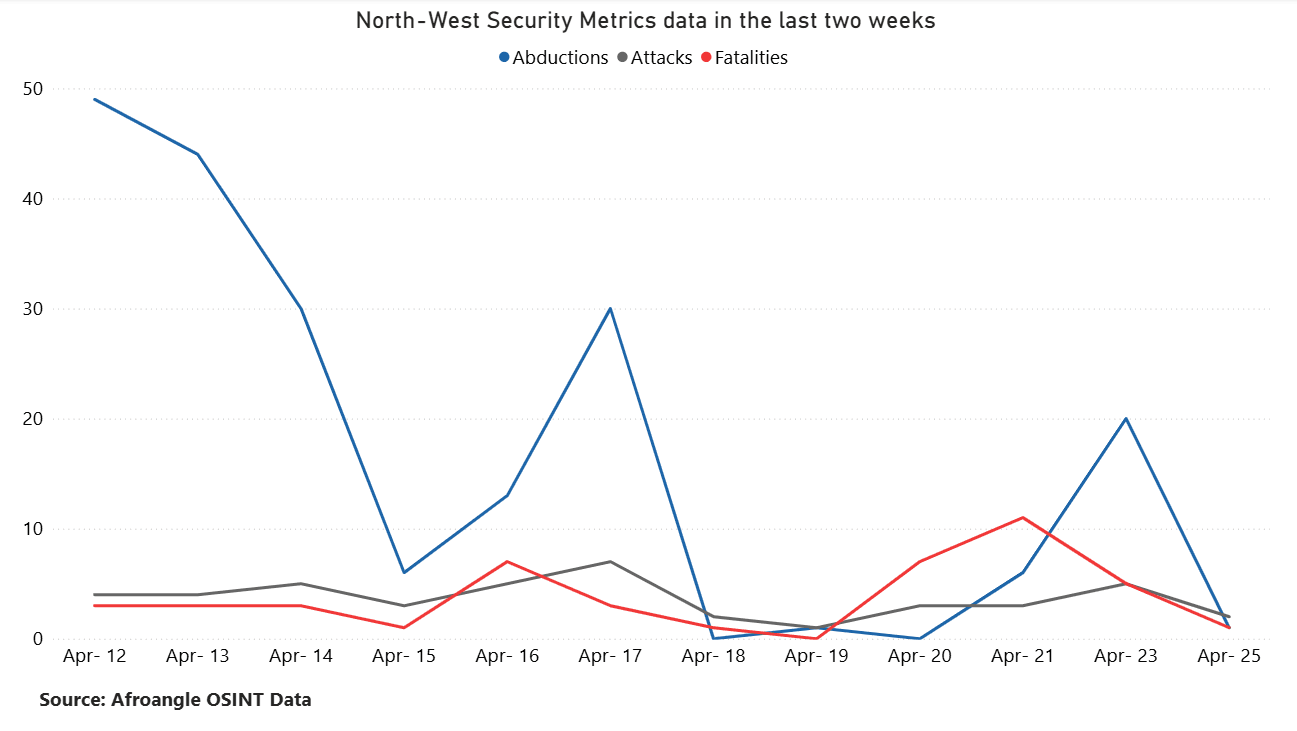
There was a decline in the intensity of attacks between April 12-25, dropping from around 4–5 incidents early in the period to about 2–3 toward the end, despite minor fluctuations. This downward trend suggests a gradual reduction in coordinated or frequent attack activities over time, likely due to increased security operations.
Analysis: Offensive Operations in the North-East Yield Significant Gains
Following a series of insurgent attacks on military bases and civilian populations, including the temporary seizure of strategic locations such as Ngoshe and the killing of senior military officers in recent weeks, the Nigerian military has expanded its offensive operations and recorded notable gains. These operations have significantly degraded the operational capabilities of insurgent groups, particularly the Islamic State West Africa Province (ISWAP). Backed by coordinated airstrikes and ground assaults, the military extended its offensive into key insurgent strongholds across the Lake Chad basin and the Mandara Mountains. In Buratai, for instance, an attack on a military base was successfully repelled, resulting in the killing of two ISWAP fighters.
One of the most significant developments was the operation in Kukareta, near Damaturu, which led to the killing of at least 24 ISWAP fighters, including a senior commander, Abu Umar Bundi Munzir. This represents a substantial blow to both the rank-and-file and leadership structure of the group and is likely to disrupt its operational cohesion in the short term. Military offensives and clearance operations also extended to the Tuba axis in Nganzai and areas around Kukawa, including Jilli, which was recently a site of the Military airstrike and has drawn concern due to reports alleging significant civilian casualties alongside insurgent losses. This highlights the complex trade-offs inherent in high-tempo operations and the need for precision and accountability to sustain local trust.
The military maintained an aggressive operational tempo throughout the week. Airstrikes in Mallam Fatori reportedly killed over 30 ISWAP fighters and disrupted key logistics networks by destroying boats and waterways used for insurgent movement and supply chains. These actions indicate a deliberate effort to target not only fighters but also the logistical backbone sustaining insurgent operations. Overall, this surge in offensive activity appears to be a direct response to recent frontline setbacks and represents a necessary recalibration of military posture. While these gains are commendable, their impact will depend on sustained momentum. This requires continuous logistical support to frontline troops, timely reinforcements, and rapid, well-coordinated air support to maintain pressure on insurgent strongholds.
At the same time, the nature of insurgency suggests that as pressure intensifies, insurgent elements may disperse, regroup, or embed within civilian populations. This creates additional risks and underscores the need for enhanced surveillance, disciplined targeting, and vigilance to prevent spillover into civilian areas. Strengthening coordination along the border regions with Niger and Chad is also critical, as losses among insurgent fighters may prompt efforts to draw reinforcements from affiliated networks across borders. Without strengthened battlefield intelligence and regional coordination, current gains risk being temporary.
Outlook
In the coming weeks, armed group activity in the North-west is expected to persist, with continued attacks targeting civilian communities. At the same time, the Nigerian military is likely to sustain and intensify its counter-terrorism operations against both bandit and insurgent groups across the region.
In the North-East, insurgent groups are also expected to continue testing the military’s operational resolve, likely through probing attacks aimed at slowing or disrupting ongoing offensives. The effectiveness of these offensives will depend largely on the preparedness, adaptability, and resilience of deployed troops.
The military is expected to maintain its forward momentum by advancing deeper into insurgent-held territories and intensifying air campaigns to further degrade insurgent capabilities. However, the success of these operations will ultimately depend on their coordination and sustainability. Tactical and operational gains must be consolidated and translated into broader strategic outcomes that address the underlying structural drivers of insecurity across the region.
Without this alignment, there is a risk that short-term battlefield successes may not produce lasting stability.
Adam Abass
Adam Abass is a graduate student of political science and international relations. His research focuses on Middle Eastern politics, counter-terrorism, peace, and security in Africa.
comments
No comments yet